Steinberg Stages Of Osteonecrosis-Avascular Necrosis

Steinberg Staging Of Avascular Necrosis/ Osteonecrosis

History and etymology

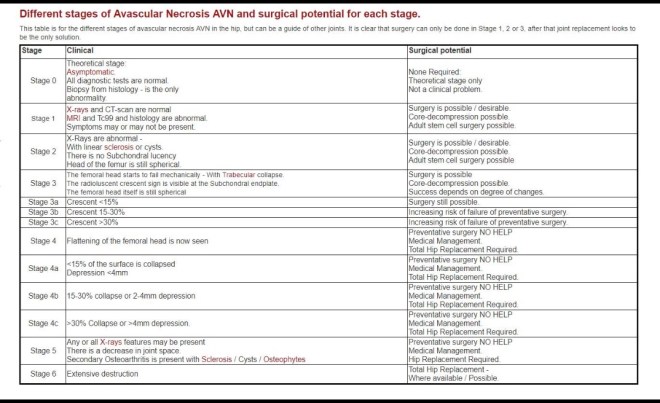
It is based on the radiographic appearance and location of lesion. It primarily differs from the other systems by quantifying the involvement of femoral head which allows direct comparison between series1. Seven stages of involvement are identified. Following staging, extent of involvement of femoral head is recorded as mild, moderate or severe.

Classification

stage 0: normal or non-diagnostic radiographs, MRI and bone scan of at risk hip (often contralateral hip involved, or patient has risk factors and hip pain)

stage I: normal radiograph, abnormal bone scan and/or MRI

stage II: cystic and sclerotic radiographic changes

stage III: subchondral lucency or crescent sign

stage IV: flattening of femoral head, with depression graded into

mild: <2 mm

moderate: 2-4 mm

severe: >4 mm

stage V: joint space narrowing with or without acetabular involvement

stage VI: advanced degenerative changes

Quantification of extent of involvement is necessary for stages I to V:

stage I and II

A, mild: <15% head involvement as seen on radiograph or MRI

B, moderate: 15% to 30%

C, severe: >30%

stage III

A, mild: subchondral collapse (crescent) beneath <15% of articular surface

B, moderate: crescent beneath 15% to 30%

C, severe: crescent beneath >30%

stage IV

A, mild: <15% of surface has collapsed and depression is <2mm

B, moderate: 15% to 30% collapsed or 2 to 4mm depression

C, severe: >30% collapsed or >4mm depression

stage V

A, B or C: average of femoral head involvement, as determined in stage IV, and estimated acetabular involvement.

Steinberg Staging Osteonecrosis

See also

Avascular Necrosis Of The Hip

Fixated and Arlet Staging

Legg-Calvé Perthes Disease

AVN CharityUK

References

1. Steinberg ME, Hayken GD, Steinberg DR. A quantitative system for staging avascular necrosis. J Bone Joint Surg Br. 1995;77 (1): 34-41. Pubmed citation
How Our Joints Work and Move

How Our Joints Work

Joints are the place where two or more bones meet. All of your bones, except for one (the hyoid bone in your neck), form a joint with another bone. Joints hold your bones together and allow your rigid skeleton to move.

Fixed joints
Some of your joints, like those in you skull, are fixed and don’t allow any movement. The bones in your skull are held together with fibrous connective tissue.

Slightly movable joints
Other joints such as those between you vertebrae in your spine, which are connected to each other by pads of cartilage, can only move a small amount.

Synovial movable joints
Most of your joints are “synovial joints”. They are moveable joints containing a lubricating liquid called synovial fluid. Synovial joints are predominant in your limbs where mobility is important. Ligaments help provide their stability and muscles contract to produced the desired movement. The most common synovial joints are listed here:

Ball and socket joints, like your hip and shoulder joints, are the most mobile of joints in the human body. They allow you to swing your arms and legs in many different directions.
Hinge joints like in your knee and elbow , enable movement similar to opening and closing a hinged door.
The pivot joints in your neck allow you to turn you head from side to side.
Ellipsoidal joints such as the joint at the base of your index finger, allow bending and extending, rocking from side to side, but rotation is limited.
Gliding joints occur between the surfaces of two flat bones that are held together by ligaments. Some of the bones in your wrists and ankles work by gliding against each other.

Conyloid joints. These joints are similar to ball-and-socket joints, just without the socket (the “ball” simply rests against another bone end).
Saddle joints are found in your thumbs, the bones in a saddle joint can rock back and forth and from side to side, but they have limited rotation.


yoga

Avascular Necrosis – Osteonecrosis eBooklet © ™️®️


Click link below


AVN Awareness Booklet    

To access link on cell press on above link and you will be re-directed to Booklet.

If on computer just click above link.

🌻 Hi, I’m Deborah Andio

I wrote this booklet in 2016  to help patients like myself and their families understand avascular necrosis- osteonecrosis  and give helpful ideas to patients and help our doctors understand the pain we often feel.

My goal is throughout this booklet is to first let you know you are not alone .

Those who also have been diagnosed with avn know exactly how your feeling,scared, afraid, searching for knowledge and resources and coming up with very little.

That’s why I started a support group and wrote this booklet.

Disclaimer

  • This booklet is not intended as a substitute for the medical advice of physicians. The reader should regularly consult a physician in matters relating to his/her health and particularly with respect to any symptoms that may require diagnosis or medical attention.
  • No part of this eBook may be reproduced or transmitted in any form or by any means, electronic or mechanical, including photocopying, recording or by any information storage and retrieval system, without written permission from the author.
  • The information provided within this eBook is for general informational purposes only.
  • Copyright © protected
  • While I try to keep the information up-to-date and correct, there are no representations or warranties, express or implied, about the completeness, accuracy, reliability, suitability or availability with respect to the information, products, services, or related graphics contained in this eBook for any purpose. Any use of this information is at your own risk.

I give an actual copy to members of my support group. But many felt the information was so helpful, I wanted to share it with everyone.

I have recently completed a better spell check and next print will have all errors corrected.

No-one can use any contents of this booket words or graphics

Also booklet will be updated every 2 years

2014 check

2016

2018

2020

I am continually writing to our Senators state by state asking for an awareness day proclamation.

So AVN-ON can get the recognition it deserves.


Supprt Group Link  Avascular Necrosis/ Osteonecrosis Support Int’l

Wishing you all a pain free and relaxingI am

God Bless

Debbie


ChronicallyGratefulDebla2018© ™️

Debla©2014-2019 ™️


All rights reserved. Thia booklet on line or in print may not be reproduced in any form, stored in any retrieval system, or transmitted in any form by any means—electronic, mechanical, photocopy, recording, or otherwise—without prior written permission of the publisher, except as provided by United States of America copyright law. For permission requests, write to the author on this web site.

©Debla2014


computer