November 29: Osteonecrosis (Avascular Necrosis) Awareness Day

November 29: Osteonecrosis (Avascular Necrosis) Awareness Day

Shining a Light on a Silent but Life-Changing Bone Disease

Every year, November 29 marks Osteonecrosis Awareness Day—a day dedicated to educating, empowering, and supporting the millions of people worldwide living with osteonecrosis, also known as avascular necrosis (AVN).

Osteonecrosis is a painful, progressive condition where bone tissue dies due to loss of blood supply. Without proper blood flow, the affected bone weakens, collapses, and can lead to severe arthritis and disability. While many people have never heard of it until diagnosis, AVN is far more common than most realize.

Today, we honor the fighters, the caregivers, and the advocates raising their voices so no one has to face this disease alone.

What Causes Osteonecrosis?

Osteonecrosis can develop for many reasons, but the underlying issue is always the same: interrupted or reduced blood flow to the bone.

Here are some of the most common causes and risk factors:

  1. Blood Clotting Disorders

When the tiny vessels supplying bone become blocked by clots, the bone tissue can’t receive oxygen. Conditions that increase clotting can drastically raise the risk of AVN.

  1. Injury or Trauma

A broken bone, dislocation, or major joint injury can damage blood vessels and trigger osteonecrosis—sometimes months or years later.

  1. Steroid Use

High-dose or long-term corticosteroid use is one of the most common causes of non-traumatic AVN. Steroids can raise lipid levels and alter marrow pressure, reducing blood flow.

  1. Excessive Alcohol Use

Heavy drinking increases fatty deposits in the blood, which can block circulation to the bone over time.

  1. Chemotherapy and Radiation

Cancer treatments can weaken bone structure and reduce blood flow, increasing the risk of AVN during or after treatment.

  1. High Cholesterol

Elevated lipids can thicken and narrow blood vessels, interfering with oxygen delivery to bone tissue.

  1. Smoking

Nicotine constricts blood vessels, reduces oxygen circulation, and slows healing—making AVN more likely and more aggressive.

  1. Idiopathic Cases (No Known Cause)

Some people develop osteonecrosis without any identifiable reason. This can be one of the most frustrating parts of the disease.

Signs & Symptoms to Watch For

Osteonecrosis often begins subtly, but early detection can slow progression.

Common symptoms include:
• Deep joint pain (often hip, knee, shoulder, ankle)
• Pain with weight-bearing
• Limited range of motion
• Night pain
• A limp or stiffness

Early diagnosis is critical—and MRI is the gold standard for catching AVN before collapse.

Treatment Options for Osteonecrosis

The best treatment depends on the stage of the disease and the joint involved. The earlier AVN is found, the more joint-preserving options are available.

Regenerative & Non-Surgical Treatments

These may help slow or stop progression in early stages:

  • PRP (Platelet-Rich Plasma)
    Uses the patient’s own platelets to stimulate healing and reduce inflammation.
  • Stem Cell Therapy
    Mesenchymal stem cells can support bone regrowth and improve blood flow.
  • A2M (Alpha-2-Macroglobulin Therapy)
    A natural protein that can help control inflammation and breakdown of cartilage.
  • Physical Therapy
    Helps maintain strength, mobility, and joint function while reducing pain.
  • Hyperbaric Oxygen Therapy (HBOT)
    High-pressure oxygen may help restore blood supply and support bone repair.

Surgical Options When Damage Has Advanced

  • Core Decompression

A surgeon removes part of the inner bone to reduce pressure and encourage new blood flow.

  • Bone Grafting

Healthy bone is transplanted to replace damaged tissue.

  • Total Joint Replacement

In later stages, when collapse or arthritis has occurred, joint replacement may provide pain relief and restore mobility.
Hips, knees, and shoulders are the most commonly replaced joints in advanced AVN.

Why Awareness Matters

Far too many people are diagnosed late, when the bone has already collapsed—limiting treatment choices and increasing the likelihood of joint replacement.

Awareness means:
• earlier detection
• more treatment options
• better outcomes
• improved quality of life

By sharing information, supporting research, and elevating patient voices, we help others find answers faster and feel less alone.

On this Osteonecrosis Awareness Day, let’s stand together—patients, caregivers, advocates, and medical professionals—and continue to push for earlier diagnosis, better treatments, and more compassion for those living with AVN.

Whether your journey began from an injury, steroids, alcohol, a medical treatment, or for no known reason…
your story matters, your pain is real, and your strength is inspiring.

You are not alone, and your voice raises awareness that could change someone else’s life.

AVN #osteonecrosis #awareness #bonedeath #AvascularNecrosis

http://www.joint-purpose.com
http://www.avascularnecrosiseducation.com

Shining Light on Avascular Necrosis-Osteonecrosis Awareness Day: A Call for Unity

As we approach November 29, a day etched on our calendars as Avascular Necrosis-Osteonecrosis Awareness Day, the enthusiasm is palpable. Originating in states like Ohio, Pennsylvania, Iowa, Georgia, and Tennessee, and several other states this day has grown beyond its regional roots, capturing hearts and minds across the nation. A celebration of resilience, unity, and the strength of those battling this rare disease, the journey has just begun. We still have many states that have yet to recognize this awareness day.

In the spirit of reflection and progress, let’s take a closer look at what Avascular Necrosis-Osteonecrosis is and why it deserves the spotlight. Osteonecrosis occurs when the blood supply to a bone is disrupted, leading to the death of bone tissue. While it can affect anyone at any age, the rarity of this condition often results in delayed diagnosis and limited awareness.

Imagine a disease that doesn’t discriminate by age, gender, or background—a condition that can strike unexpectedly, altering lives in its wake. Avascular Necrosis-Osteonecrosis fits this description, emphasizing the importance of education and advocacy. It’s crucial to understand the pain that accompanies this condition. The affected bones, deprived of essential blood supply, lead to excruciating pain, impacting mobility and quality of life.

This awareness day isn’t just a commemoration; it’s a call to action. The commendable efforts of states like Ohio, Pennsylvania, Iowa, Georgia, and Tennessee have set the stage for a nationwide movement. Proclamations have been issued, voices have been amplified, and the journey towards recognition has begun.

As we celebrate the strides made, it’s essential to acknowledge the work that lies ahead. Advocacy is a journey, not a destination, and the goal is clear: to have all 50 states recognize and celebrate Avascular Necrosis-Osteonecrosis Awareness Day by 2024. This ambitious vision requires a collective effort.

To our esteemed congressmen, senators, and the President of the United States, we extend an invitation to join us in this noble cause. Avascular Necrosis-Osteonecrosis doesn’t discriminate based on political affiliations, and neither should our pursuit of awareness. We implore you to consider the impact of this rare disease on your constituents, urging you to champion the cause for an awareness day in every state.

It’s not a daunting task; it’s an opportunity for bipartisan collaboration, demonstrating a commitment to the health and well-being of the American people. A simple proclamation can go a long way in raising awareness, fostering empathy, and providing support to those affected by Avascular Necrosis-Osteonecrosis.

In the coming year, let’s collectively work towards making November 29 a day of national significance. Together, we can ensure that the stories of those touched by Avascular Necrosis-Osteonecrosis are heard, recognized, and celebrated from coast to coast. The journey has just begun, and with your support, we can light up the map with awareness, compassion, and unity.

Sincerely

Deb Andio

Founder

Avascular Necrosis-Osteonecrosis SuppooInt’l

http://www.avascularnecrosiseducation.com

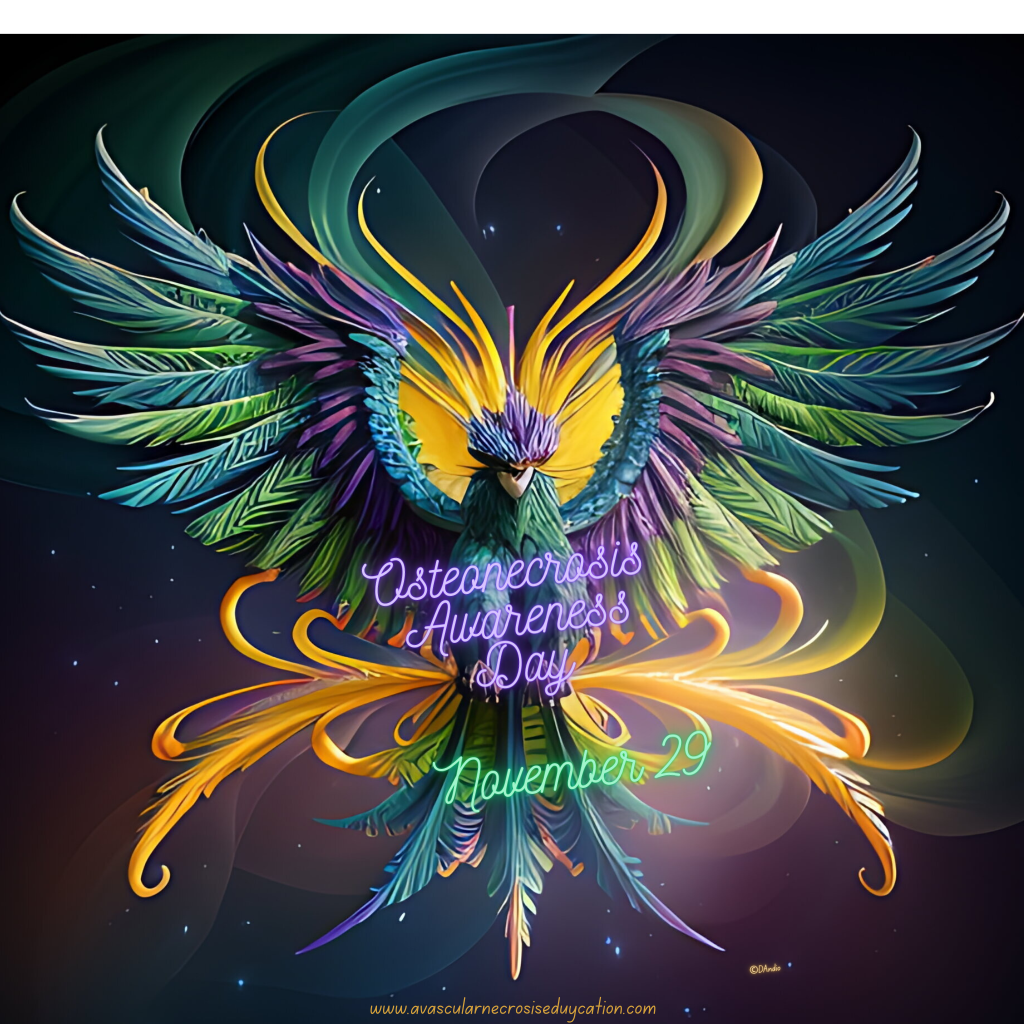
“Like the majestic Phoenix that rises from the ashes, those of us living with Osteonecrosis are on a journey of resilience and hope. As we continue to advocate for awareness, we believe that our Awareness Day will soon shine worldwide, illuminating the path for understanding, support, and compassion. Together, our voices will soar, echoing the strength that lies within each of us.”

Osteonecrosis- and New Logo Designs More to Come.

Hey everyone! Today I want to talk about a topic that is close to my heart – osteonecrosis. Living with this rare condition can be really challenging, both physically and mentally. Osteonecrosis occurs when there is a lack of blood supply to the bone and joint, which can eventually lead to the collapse of the bone and the need for a joint replacement. It’s a tough journey, but remember, you’re not alone.

There are various underlying causes for osteonecrosis, including trauma to the bone or joint, blood clotting disorders, autoimmune conditions, cancer treatments like radiation and chemotherapy, as well as certain diseases like vasculitis, lupus, HIV, and sickle cell anemia. Lifestyle factors such as smoking and excessive drinking can also contribute to the development of osteonecrosis. Additionally, the chronic use of corticosteroids is a known cause for many individuals.

However, it’s crucial to note that not everyone who experiences these factors will develop osteonecrosis. Each person’s journey with this condition is unique, and it’s important not to blame ourselves or feel guilty for something that may be beyond our control.

But here’s the thing – we need better treatment options for osteonecrosis. Having access to alternative medications like platelet-rich plasma (PRP) therapy can make a significant difference in managing this condition and potentially preventing the need for joint replacements. PRP therapy involves using a concentrated form of a patient’s own blood to promote healing and regeneration in the affected area.

Unfortunately, insurance companies often don’t cover PRP therapy or other alternative treatments for osteonecrosis. This makes it challenging for individuals to explore all available options to manage their condition effectively. We need to raise awareness about the importance of these treatments and advocate for insurance coverage, ensuring that everyone has access to the best possible care.

So, let’s come together and spread awareness about osteonecrosis. Share your experiences and knowledge, support one another, and join the fight for better treatment options. Together, we can make a difference in the lives of those living with this condition. Don’t forget to use the hashtags #OsteonecrosisAwareness and #JointHealthMatters to amplify our message.

Remember, everyone’s journey is unique, but together we can make a difference. Let’s continue to spread awareness and support one another in this fight against osteonecrosis. Stay strong, warriors! 💪🙌

The Guardian

I’m excited to share with you one of the new logo designs for Osteonecrosis awareness! Introducing “The Guardian” – a symbol of strength, protection, and unity in the fight against this rare condition.

The logo features a bold and powerful image of a guardian angel with outstretched wings, symbolizing the support and protection we offer to those affected by osteonecrosis. The angel is seen holding a bone, representing the importance of bone health and the need to raise awareness about this condition.

The color palette chosen for the logo reflects the resilience and determination of individuals living with osteonecrosis. Shades of blue and purple evoke a sense of calmness, hope, and empowerment, while the green is for life and the touch of gold -white adds a touch of elegance and sophistication.

The Guardian logo aims to capture attention and spark curiosity, encouraging individuals to learn more about osteonecrosis and become advocates for better treatment options and insurance coverage. By using this logo, we are creating a unified and recognizable symbol that can be shared across social media platforms, websites, and events, creating a sense of community and solidarity.

As an influencer, it’s essential for me to use my platform to spread awareness and support those affected by osteonecrosis. I encourage you all to join me in using the hashtag #GuardianOfBoneHealth when sharing posts related to this condition and the new logo. Let’s come together and make a positive impact in the lives of individuals battling osteonecrosis.

Stay strong and keep fighting, warriors! 💙💜💚

Logo 2 The Multi-Phoenix

Also is

The phoenix is a powerful symbol of transformation and resilience, which aligns perfectly with the journey of those living with osteonecrosis. By incorporating the phoenix logo into our social media posts, we can further emphasize the strength and determination of individuals battling this condition.

Let’s use the hashtag #RisingStrong to accompany posts featuring the phoenix logo. Together, we can inspire hope and encourage others to rise above challenges and embrace their own inner strength.

If you’re interested in using the phoenix logo on your social media platforms, feel free to reach out to me for the high-resolution image. Let’s continue raising awareness and supporting one another in this journey of resilience.

Stay powerful, warriors! 🔥💪

Out with the old and in with the new

Being an advocate for bone and joint pain and personally living with osteoarthritis osteonecrosis and spondylolisthesis pain .

I saw our community struggle in new and ways besides living and dealing with daily pain.

People suddenly couldn’t access routine care because of lockdowns, fear and added anxiety.

They became more isolated than ever before. They and their family members faced job losses and financial hardship.

As an advocate for arthritis and a facilitator for my local LIVE YES Connect Group, I had to cancel or postpone in-person programs and events.

But on the plus side we went virtual on Zoom

Some members and their families faced added strain, whether dealing with virtual school or safety concerns for loved ones in nursing homes.

It’s a year most are happy to see come to an end.

But as a person with pain, I am always compelled to find silver linings. Even in the mist of challenging of times.

In 2020, I got to travel to Washington D.C participate in a focus group and then speak on Capital Hill.

I met some fantastic people from our state representatives to other leaders and advocates who work so hard to create a strong support system for so many causes and conditions.

I got to stay in a great city and tour the beautiful historical city of Washington D.C

We made great strides in accessibility, as health care system finally embraced telehealth and more companies allowed remote work.

Many disabled now gave hope to possibly getting a part time job working from home now because we see it is doable.

We seen a President work tirelessly to get pharmaceutical companies to create a vaccine quickly that will be safe for the USA and world.

We gave witnessed the power of science and innovation with the development of promising treatments and vaccines.

We saw our neighbors and communities come together to support one another in their time of need.

Despite the news only showing negativity there was a lot of positive happening.

2020 shown how resilient we are. And to never lose faith. Be grateful for everyday.

I don’t know what 2021 will bring;

I’m hoping it will be a fantastic year.

I just want to Thank you for your support, and following me on IG, Blog, and all social media platforms I promise to bring you current and uplifting information in 2021 and I wish you all a safe, healthy, prosperous and happy new year

Thank You Arizona

The good news keeps rolling in

Rare Disease Day is February 29 usually 28 on non leap years.

So as you know I have been working very hard on November 29 being National – Avascular Necrosis Osteonecrosis awareness day and all states have come on board so far but still waiting to hear from maybe 10 states.

They are doing all they can. And I am so pleased many states have issues proclamations for November 29 and many still are in the process.

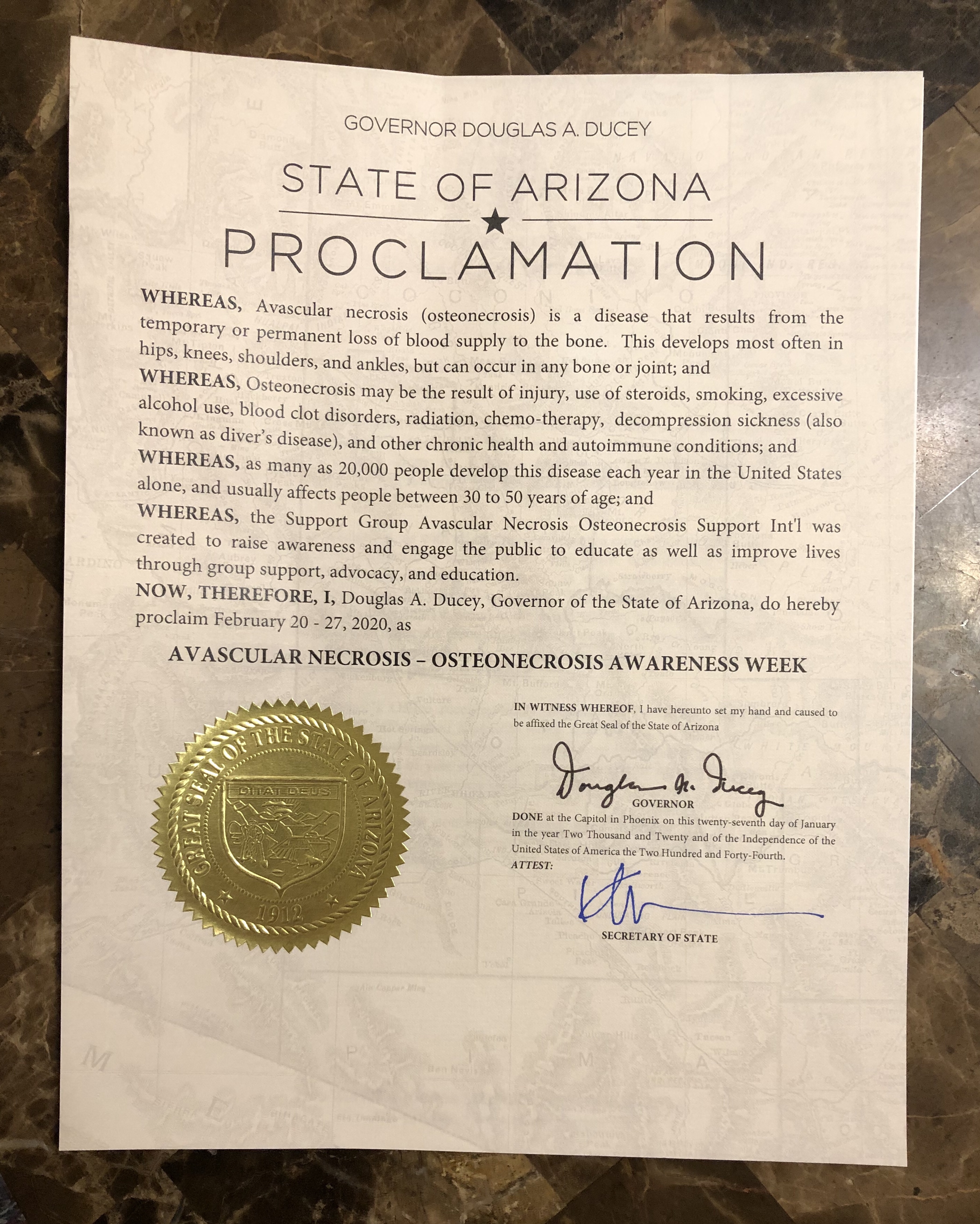
Today The State of Arizona sent a proclamation for rare disease awareness we got the entire week February 20-27

And they will also be recognizing November 29

So blessed.

Hard work pays off

Thank you State of Arizona

Deb Andio

Founder Avascular Necrosis Osteonecrosis Support Int’l

#Osteonecrisis #AvascularNecrosis

Thank You Proud Moment

Thank you to Youngstown Ohio Mayor Jamael Tito Brown and Senator Michael Rulli and Senate President Larry Obhof

What an honor

Help me raise awareness today and please like and share this post.

Thank You.

1st annual

#AvascularNecrosis #Osteonecrosis

#AwarenessDay #November29

AvascularNecrosis/Osteonecrosis Support Int’l

https://www.vindy.com/news/local-news/2019/11/city-state-recognize-poland-woman-with-rare-disease/

Meet Julie Croner

To Our Dear Readers


Often being diagnosed with a rare disease is not easy , it can often  leave you feeling alienated  exhausted and at times discouraged. We often end up having more questions than answers.


There also is very little to no public attention when you have a rare disease/disorder such as fun runs, fundraisers ,even research money  is limited when it comes to having a rare disease.


Far too often doctors may not be as educated  or skilled on a certain a rare medical condition which often causes patients to be misdiagnosed.


Those suffering often go months to years without a proper diagnosis.


Then there is the treatment options which appear just as limited.


There are about 7,000 different types of rare diseases with new discoveries every day. In the United States alone there have been approximately 25-30 million people given the diagnosis of an uncommon medical condition.


But we cannot give up. We must keep going, we must live mindfully and even in pain we must try to live our best life.


Avascular Necrosis/Osteonecrosis is one of those rare diseases and today I am happy to introduce you to the creator of it’s just a bad day not a bad life.


But before I do, I want to tell you a bit about her.


She  is the VP of WEGO Health patient network as well as a Patient Empowerer, Certified Holistic Health Coach, Yoga Instructor, Speaker and Patient Leader Blogger who is thriving with psoriatic arthritis and avascular necrosis of the femur and has battled melanoma, complex regional pain syndrome, depression, and anxiety.


Please welcome Julie Croner


She is using her personal mantra ‘It’s just a bad day, not a bad life’, she started itsjustabadday.com, which has been named one of the top 5 Psoriatic Arthritis blogs by EveryDay Health, top 7 Psoriasis blogs by HealthLine, top 40 Arthritis blogs by Feedspot and has been highlighted by The Mighty, WedMD, The National Psoriasis Foundation, and many other online sources.


Staying busy is a way of life for Julie. Some of her accomplishments and activities include:


Vice President of the Patient Leader Network for WEGO Health, 2016 Standford MedX Ignite Talk and Oral Presenter, 2014 Stanford Medicine X ePatient Scholar, Psocial Ambassador for the National Psoriasis Foundation, member of the Advocacy and Mission Committee for Arthritis Foundation, WEGO Health


Best In Show: Twitter in the 2015 Health Activist Awards, Psoriasis Social Media Ambassador and Health Guide for HealthCentral, blogger for PsoStrong.com, contributor to Everyday Health and Yoga Instructor.


Julie is an army wife and new mama. When she’s not working, Julie can be found jamming out to Celine Dion, taking a yoga class, traveling, cooking, geeking out over health-related things or enjoying life in Pittsburgh, PA.


You can find Julie at


Blog: Itsjustabadday.com


Twitter: twitter.com/justagoodlife


Facebook: Facebook.com/itsjustabaddaynotlife Instagram: Instagram.com/itsjustabaddaynotlife LinkedIn: http://www.linkedin.com/in/juliecerrone


Blog Email: justabaddaynotlife@gmail.com


Please welcome Julie Cerrone


So Julie : How long have you had Avascular Necrosis -Osteonecrosis?Where do you have avn-on?


I was diagnosed with AVN in my left femur bone in December of 2012.


Is your Avascular necrosis in more than one joint or bone?


It was in just one bone, but I had 2 places within the bone. A smaller section and then a larger section that was crumbling due to me putting weight on my leg.


How did you feel when you were diagnosed?


Up to the day I was diagnosed I had been continuously going to my doctor complaining I was in pain. I had 2 back to back surgeries (my 4th and 5th knee surgeries overall), had been in therapy, was on crutches and was in so much pain I had been unable to work for the previous 6 months. He kept saying that there wasn’t anything wrong – but I pushed for every test under the sun.


I’ll always remember December 17th, 2012 and the look on my doctor’s face when he came into my exam room. He said you have AVN. I know what it is, I’ve seen it before, but I don’t know really how to best treat it and I don’t know where to send you.


I’m a pretty positive person – but hearing that from someone I had trusted for years as my orthopedic surgeon really hit me. I literally went home, laid on the couch and cried for the rest of the night. I had NO idea bone could die. And for my doctor to tell me he had no idea what to do . . . . that was hard.


Did they say what may have been the cause of your avn-on?


So obviously no one can pinpoint it exactly, but this is what I have deduced from reflecting on it for the past 7 years.


In February of 2012, I started having knee problems. I had had knee problems my whole life, so it was kinda like “here we go again” thing in the back of my mind.


As months went on, it wasn’t getting any better – in fact it was getting worse. I went to my orthopedic and in June I had surgery. I ended up going back into the OR in September because I was still in so much pain.


Looking back, it’s very clear to me now that there wasn’t anything surgery could have fixed- I was having a psoriatic arthritis flare. In middle school a doctor had suggested that I had PsA but I never took it seriously because 1) I had no idea what it was 2) I was young and thought there’s no way I had arthritis.


December 26th, 2012 (right after I was dx with AVN) I ended up in the hospital because I was in so much pain I couldn’t stop shaking. That’s when I was officially dx with psoriatic arthritis.


A year after getting diagnosed with AVN I found out that I have prothrombin thrombophilia which is a blood clotting mutation. Basically, I think that the mutation predisposed me to be susceptible to AVN, and then coupled with the back to back unneeded surgeries and a psoriatic arthritis flare = the perfect storm.


Did you ever hear of avn-on before your diagnosis?


Nope. I had never heard of it. And honestly, I didn’t even know your bone could die!


What are some of the treatment options have you tried? Were any helpful?


So I was on crutches for 3.5 years. The longest ‘treatment’ I did was to stay off of it and give my knee a chance to recover. I also took pain killers around the clock to deal with the pain. I then subsequently did 2 things that ultimately got my pain under control and helped me get my life back together.


1) I took high doses of blood thinner injections to get my blood flowing to the necrosed areas of my bone. This actually worked wonders and it revived the smaller AVN part of my bone. Today on MRIs you can’t even see it!


2) I had a Regenexx stem cell procedure done. This was AMAZING. I blogged the entire journey: http://www.itsjustabadday.com/regenexx-avn-procedure/


I’m 4.5 years out from the procedure and feel amazing. I haven’t had ANY pain, ANY issues or ANY concerns. The last MRI I had was at a year out and my bone had regenerated 60%. The way it had regenerated it encapsulated the dead part that was crumbling and strengthened the bone. I’m able to live life, function, walk, run – do anything I want without any worry of AVN.


Can you tell me do you work or are you unable to work?


I was on disability for almost 4 years. I’m back to work full-time now. I’m even a yoga instructor!


How many doctors have or did you see before getting diagnosed?


I was only going to my 1 orthopedic doctor and it took me 6 months to get a proper diagnosis. But in order to TREAT my AVN, I lost track at 29 providers.


You know who ended up helping me? PATIENTS. Patients online were my saving grace and the reason I found out about the blood thinner injections and the stem cell procedure.


What would you tell someone who has been newly diagnosed with avn-on?


Stop what you’re doing, go to the Regenexx website and lookup an office near you. They’re the ones who have been doing this the longest, have the most research and help AVN patients all the time. I’m living testimony that this can work. But don’t just take my word for it – I’ve connected with hundreds of other patients who have received benefits fro the Regenexx stem cell procedure.


But on that note, be weary of stem cell procedures. I personally endorse the Regenexx procedure because of their process and their standard of quality. Others do not do it the same way they do it (even Mayo Clinic or Cleveland Clinic). Also- do not get stem cell injections that are not your own. If you’re getting anything other than your own mesenchymal stem cells you’re wasting your money.


And for those who are worried about the financial aspect of the stem cell procedure, I say this to you. Yes, it’s an investment. But without your health- what do you have? I was on disability, didn’t have a ton of money in the bank and still found a way to get it done. I’m not any more entitled than anyone else out there. If there’s a will, there’s a way.


Most people look at it from the upfront cost – but you don’t consider this…


To get a joint replacement, on average, in most markets it costs around $40k. (sure, you don’t pay all of that, but you’re paying your insurance costs). Then you’ll have follow up doctor visit, etc.


Then you have to go to therapy – for MONTHS.


With a joint replacement, you’ll be off work, you’ll be unable to really function properly for a good amount of time.


And to be blunt, a lot of people have problems with joint replacements and end up spending more time and money on fixes and follow-ups.


Oh- and also, depending on your age – you’ll need to get another one because they don’t last very long. Especially if you live an active life.


People always think that having insurance cover a core decompression or a joint replacement is the better way to go. I BEG you to think of it not in those terms. Think of YOUR LIFE. The quality of life you want to have.


By having a stem cell procedure, I not only still have my own joint, but it’s healthy and I don’t have to worry about having to go through it all again in the future.


 Name something positive that has been a result of getting avn-on?


I’ve had amazing experiences since being diagnosed with AVN. I had the opportunity to share my story of how patients were the ones who got me back to walking and regrew my femur bone at Stanford MedX: http://www.itsjustabadday.com/2017/03/09/medx-ignite-talk-replay/ (If you scroll to the bottom of the post you can see my Ignite talk)


And I was invited by the FDA to share my story on stem cells at a hearing: http://www.itsjustabadday.com/2016/09/28/fda-stem-cell-hearing/ (If you scroll down to the bottom of this post you can see my testimony)


But honestly, the most positive thing that has resulted from my diagnosis is getting to connect with patients all over the world, on a weekly basis, and helping them know they’re not alone. I try to pass on my own advice, my own journey and my own thoughts to help them feel a little less alone and to have a bit more knowledge than I did when I was in their shoes. It really helps me to know that I didn’t go through this for nothing. I went through this to help others and to really find my passion in life.


Thank you so much Julie not only for this interview but for being a great inspiration to so many and educating others while raising awareness on this rare disease. May you have continued success in your advocacy and all that you do and wishing you continued wellness.


To follow Julie on social media her links are listed below.


Blog: Itsjustabadday.com

Twitter: twitter.com/justagoodlife

Facebook: Facebook.com/itsjustabaddaynotlife Instagram: Instagram.com/itsjustabaddaynotlife LinkedIn: http://www.linkedin.com/in/juliecerrone

Blog Email: justabaddaynotlife@gmail.com


Please help raise awareness by sharing this blog post in the hopes it reaches someone who may benefit from the information provided.


*If you are interested in sharing your Avascular Necrosis -Osteonecrosis story or Group  in an interview please email me at.


If you know of someone or if you are someone who suffers from AVN-ON and you need a great support group


Click on the link to find this Facebook group – Avascular Necrosis/Osteonecrosis Support, Int’l.

 https://www.facebook.com/groups/DeadBoneDiseaseAVN/?ref=share

Also please like and subscribe to my blog and if you want to follow me you can find me at the links below.


Thank you again Julie and

 Here is wishing everyone a pain free day.


To learn more about me check out

Deborah Andio links below please like follow and share.

Thank you God Bless You.


Click on the link to visit and subscribe to my website :

www. ChronicallyGratefulDebla.com


Instagram Personal :

http://www.instagram.com/deborah_andio


Instagram Awareness Chronically Grateful Me

http://www.instagram.com/chronicallygratefulme


Twitter:


More links are in my blog


Deborah Andio

Patient Leader Blogger Empowerer