Avascular Necrosis Doctors Listed By State for USA©


I was sick and tired trying to find a doctor who know about avn-on it alone felt like a job. When I was starting my support group i heard others saying the same thing , so i set out to make a directory or doctors that treat and have some knowledge of avn. I cannot tell you how many hours i have in calling doctors  (orthos) across the country . I also have one internationally that i am working on.

Noone should have to go doctor to doctor looking for help.

I hope if you have avn this list helps you find one in your area .


Avascular Necrosis Doctors Listed By State for USA
Copyright©Debla by Deborah Andio 2015

Alabama.

Alabama Orthopaedic Surgeons
F. Spain Hodges, M.D.
Jason D. Cobb, M.D.
Donald H. Slappey, Jr., M.D.
52 Medical Park East Drive
Suite 220, Birmingham, AL 35235
Phone: 205-838-4747
Fax: 205-838-2712 | 205-838-4510

Jeffrey Wade, M.D.
Kenneth Jaffe, M.D
Robert Sorrell, M.D
3525 Independence Dr
Homewood, AL 35209
Tel 205.802.6700
Fax 205.802.6701

Andrews Sports Medicine & Orthopaedic Center Physicians
James R. Andrews, M.D.
E. Lyle Cain, Jr., M.D.
Emily Bell Casey, M.D.
Andrew M. Cordover, M.D., MS
Ricardo E. Colberg, M.D.
Jeffrey C. Davis, M.D.
Jeffrey R. Dugas, M.D.
Benton Allen Emblom, M.D.
James Adam Flanagan Jr., M.D.,FAAOS
Samuel R. Goldstein M.D., FAAOS
B. Wayne McGough, Jr., M.D.
Kathleen E. McKeon, M.D.
Cherie B. Miner, M.D.
Steven R. Nichols, M.D.
Jose (Jody) O. Ortega, M.D.
Norman E. Waldrop, III, M.D.
805 St. Vincent’s Drive, Suite 100 – Birmingham, AL 35205
2217 Decatur Highway, Suite 101 – Gardendale, AL 35071
201 Doug Baker Boulevard – Hoover, AL 35242
3143 Pelham Parkway – Pelham, AL 35124
(205) 939-3699

Dr K.David Moore
UAB Hospital – Highlands
1201 11th Avenue South
Birmingham, AL 35205
205-934-9999
205-975-BONE (2663)

Alaska

Denali Orthopedic Surgery

Dr Gardner, Dr, Pace, Dr Ellison,Dr Clyde

Mat-Su Regional Medical Plaza
2490 S. Woodworth Loop
Suite 350
Palmer, Alaska 99645
All work with AVN
Tel: 907-745-2663
Fax: 907-745-2600

Denali Orthopedic Surgery specializes in orthopedic surgery. This includes such treatments as Total Joint Replacement, Arthroscopic surgery, and fractures. They treat all areas of the body, including hand, foot, knee, and shoulder, including the back, neck and spine.

Arizona

Phillip Bennion, M.D.
Brandon Gough, M.D
Jimmy Chow, M.D
Hedley Orthopaedic Institute & Mountain Vista Surgical Specialists
2122 E. Highland Ave. Suite 300
Phoenix, AZ 85016
Mountain Vista Surgical Specialists
10238 E. Hampton Ave. Suite 406
Mesa, AZ 85209

For Patient Appointments Call: (602) 553-3113

Arkansas

Arkansas Specialty Orthopaedics
600 S. McKinley
Little Rock, AR 72205
501.663.3647

Arkansas Specialty Orthopaedics
1525 Country Club Road
Sherwood, AR 72120
501.663.3647

California

Southern California Orthopedic Institute
2400 Bahamas Dr
Bakersfield, CA
(661) 328-5565
http://www.scoi.com/

Amir A. Jamali, MD, FACS
Sacramento Office
2825 J Street,#440
Sacramento, CA 95816
(916) 492-2110
Walnut Creek Office
130 La Casa Via, Bldg 3, Suite 111
Walnut Creek, CA 94598
(925) 322-2908
Fremont Office
39180 Farwell Dr.
Fremont, CA 94538
(510) 404-3727
http://www.jointpreservationinstitute.com/

Mauro Giordani, MD
4860 Y St #3800, Sacramento, CA 95817
(916) 734-2700

Mark Jo MD
10 Congress St.
#103
Pasadena, CA 91105
(626) 795-0281

Colorado

ROGER MURKEN
303-233-1223
TOPDOC2015
660 Golden Ridge Road, Suite 250
Golden, CO 80401
HONORED IN THESE SPECIALTIES:
2015 Orthopedic Surgery
HOSPITAL AFFILIATIONS:
Ortho Colorado, Littleton

ANDREW W. PARKER
303-321-6600
TOPDOC2015
4700 E. Hale Parkway, Suite 550
Denver, CO 80220
HONORED IN THESE SPECIALTIES:
2015 Orthopedic Sports Medicine
2015 Orthopedic Surgery
2014 Orthopedic Surgery
2014 Orthopedic Sports Medicine
2013 Orthopedic Sports Medicine
2013 Orthopedic Surgery

AMIT AGARWALA MD
303-233-1223
660 Golden Ridge Road, Suite 250
Golden, CO 80401
2008 Orthopedic Surgery
HOSPITAL AFFILIATIONS:
Lutheran, St. Anthony, 84th Avenue

Amer Mei-Dan MD
Assistant Professor Orthopedics
Clinic Phone: 303-441-2219 (Phone)
303-441-2230 (Fax)
Specialty: Orthopedic Sports Medicine
Location: Boulder – CU Sports Medicine – Specialty Clinic
311 Mapleton Avenue
Boulder, CO 80304
Cynthia Kelly, MD
1601 E 19th Avenue , Suite 3300
Denver, CO 80218
Phone: (303) 837-0072
Fax: (303) 837-0075

Connecticut

Dr. John Keggi
Dr. Robert Edward Kennon
3 Locations
Orthopaedics New England
Middlebury Office: 1579 Straits Turnpike
Middlebury, CT 06762
For Patient Appointments Call: 203-598-0700

Orthopaedics New England
New Milford Office: 11 Old Park Ln.
New Milford, CT 06776
For Patient Appointments Call: 203-598-0700

Orthopaedics New England
Orthopaedics New England – Hartford Office 399 Farmington, Ave.
Lower level-1 Farmington, CT 06032 Hartford Area Office
For Patient Appointments Call: 203-598-0700

Hip, Joint Replacement, Knee, Shoulder

Delaware

Andrew J. Gelman, MD
1096 Old Churchmans Road
Newark, DE 19713

For Patient Appointments Call: 302-655-9494

Specialties: Foot & Ankle, Fracture Care, Hand & Elbow, Hip, Joint Replacement, Knee, Shoulder, Sports Medicine, Forensic Orthopaedics

Florida
Orlando Orthopedic center
Orlando, Oviedo,Winter Park Florida
4072542500
3 locations
Hip Dr Jeffery Rosen MD

Knee Dr Jeffery Rosen MD

Talus Dr Joseph D. Funk, D.P.M.

Steven J Lalliss MD
5 Locations
1
Chimney Lakes
9560 Crosshill Blvd
Ste 110
Jacksonville, FL 32222
904-635-1901
2
Northeast Florida Orthopedics
7855 Argyle Forest Blvd
Suite 503
Jacksonville, FL 32244
904-635-1901
3
Northeast Florida Orthopedics
1679 Eagle Harbor Pkwy
Ste C
Fleming Island, FL 32003
904-635-1901
4
800 W Central Texas Expy
Suite 175
Harker Heights, TX 76548
254-618-1095
5
Riverside
2627 Riverside Ave
Jacksonville, FL 32204
904-634-0640

Jewett Orthopaedics 1285 Orange Ave Winter Park, FL 32789 Winter Park Fl 32789 United States

http://www.jewettortho.com/contact-us/

Harry Steinman MD
2 Locations
Ptak Ortho-Neuro Science Pavilion
430 Morton Plant St
Ste 301
Clearwater, FL 33756
727-461-6026
1526 Lakeview Rd
Clear water, FL 33756

David D Dore MD
Celebration Village
410 Celebration Pl
Ste 106
Kissimmee, FL 34747
407-303-4270
and
South Orange
Orlando Orthopedic Center
100 W Gore St
Ste 500
Orlando, FL 32806
407-254-2500

Orthopaedics and Sports Medicine Institute,
University of Florida
Dr Gray
Dr Scott Myers
3450 Hull Rd, Gainesville, FL 32607
Phone:(352) 273-7001

Dr Dennie
Sacred Heart Health System –
5151 N. Ninth Avenue – Pensacola, FL 32504 –
(850)-434-5770

Anthony Noble MD
4Locations
Botanica
Palm Beach Orthopedic Institute
2055 Military Trl
Ste 200
Jupiter, FL 33458
561-694-7776
2
Palm Beach Orthopedic Institute
1411 N Flagler Dr
Ste 9800
West Palm Beach, FL 33401
561-694-7776
3
Palm Beach Orthopedic Institute
10111 Forest Hill Blvd
Rm 231
Wellington, FL 33414
561-694-7776
4
Palm Beach Orthopedic Institute
4215 Burns Rd
Palm Beach Gardens, FL 33410
561-694-7776

Georgia

Nathan A. Jove, M.D
2801 N Decatur Rd Ste 200
Decatur, GA 30033
7705643393

Muariec Jove, M.D
2801 N Decatur Rd Ste 200
Decatur, GA 30033
7705643393

Hawaii

Peter Matsuura, MD
670 Ponahawai St. Suite 214
Hilo, Hawaii 96720

For Patient Appointments Call: 808-969-3331

shoulder, knee, hip, elbow, wrist, hand, ankle, foot, including: bones, joints, muscles, tendons and ligaments.

Robert Medoff, M.D
Stuart Wakatsuki, M.D
Linda Rasmussen, M.D
Kevin H. Higashigawa, MDWindward Orthopedics
Kailua Professional Center
30 Aulike Street
Suite 201
Kailua, HI 96734

For Patient Appointments Call: 808-261-4658
shoulder, knee, hip, elbow, wrist, hand, ankle, foot, including: bones, joints, muscles, tendons and ligaments.

Idaho

Joseph Bowen, MD
Coeur d alene – Bowen Orthopedic Clinic, 1296 E. Polston Avenue, Suite B
Post Falls, ID 83854

For Patient Appointments Call: 208-457-7075
shoulder, knee, hip, elbow, wrist, hand, ankle, foot, including: bones, joints, muscles, tendons and ligaments.

Illinois
 
Rush University Medical Center
1653 W. Congress Pkwy.
Chicago, IL 60612
Phone: (888) 352-7874


Genesis Orthopedics & Sports Medicine
2900 Foxfield Rd. Suite 102
St. Charles, IL 60174
Phone: (630) 377-1188
Fax: (630) 377-7360

Genesis on Facebook Genesis on Twitter Genesis on Google+ E-Mail Genesis

Dr. Shadid’s Office Hours

MON: 8:45 a.m.-5:00 p.m.
WED: 8:45 a.m.-12:00 p.m.
THU: 8:45 a.m.-5:00 p.m.

General Office Hours

MON: 8:45 a.m.-5:00 p.m.
TUE: 9:00 a.m.-3:00 p.m.
WED: 8:45 a.m.-3:00 p.m.
THU: 8:45 a.m.-5:00 p.m.
FRI: 9:00 a.m.-3:00 p.m.
Oakbrook Terrace Office

1 TransAm Plaza Dr. Suite 460
Oakbrook Terrace, IL 60183
Phone: (630) 377-1188
Fax: (630) 377-7360

Dr. Shadid’s Office Hours

WED: 1:30 p.m.-5:00 p.m.

Genesis Orthopedics & Sports Medicine
2900 Foxfield Rd. Suite 102
St. Charles, IL 60174
Phone: (630) 377-1188
Fax: (630) 377-7360

Oakbrook Terrace Office
1 TransAm Plaza Dr. Suite 460
Oakbrook Terrace, IL 60183
Phone: (630) 377-1188
Fax: (630) 377-7360
http://genesisortho.com

Richard A. Berger, M.D Hip & Knee Reconstruction and Replacement
John J. Fernandez, M.D. Hand ,Wrist & Elbow
George Holmes Jr M.D Foot & Ankle
Orthopedic Building at Rush University Medical Center
1611 West Harrison Street
Chicago, IL 60612
Toll free: 877 MD BONES (877.632.6637)
Phone: 312.243.4244
Fax: 708.409.5179

Rush Oak Park Hospital
610 South Maple Avenue, Suite 1550
Oak Park, IL 60304
Toll free: 877 MD BONES (877.632.6637)
Phone: 312.243.4244     Fax: 708.409.5179

Hand-Wrist -Elbow Shoulder- -Foot -Ankle
Central DuPage Hospital – Outpatient Services
Outpatient Services Building
Suite #505
25 North Winfield Road
Winfield, IL 60190
Toll free: 877 MD BONES (877.632.6637)
Phone: 630.682.5653
Fax: 708.409.5179Prairie Medical Center of Westchester
2450 S. Wolf Road, Suite F, 2nd Floor
Westchester, IL 60154
Toll free: 877 MD BONES (877.632.6637)
Fax: 708.409.5179Occupational Health Clinic
2450 S. Wolf Road, Suite I, 2nd floor
Westchester, IL 60154
Phone: 708.273.8400Indiana Office
9200 Calumet Avenue
Munster, IN 46321
Toll free: 877 MD BONES (877.632.6637)
Opening October 2015!

Indiana

Joseph Koscielniak, MD
Orthopaedics Inc. of Indiana 5587 Broadway
Merrillville, IN 46410

For Patient Appointments Call: 219-884-3761

oint Replacement, Arthroscopic Joint Reconstruction, Sports Medicine, Upper Extremities, Joint Replacement, Spine Surgery, Hand Surgery, Arthroscopic Surgery

Iowa

Dr. Christopher E. Scott, MD
Dr. John C. Langland, MD
Dr. Brian P. Wills, MD
2751 Northgate Drive
Iowa City, IA 52245
(319) 338-3606 (Office)
(319) 338-0522 (Fax)

Dr. Lisa Coester, MD
202 10th St SE
Cedar Rapids, IA 52403
319-398-1500

Dr. Michael Hendricks
600 N Main St, Burlington, IA 52601 Show More
903 Oak St, Burlington, IA 5260
319-758-9133

Dr. Jeffrey Davick
6001 Westown Pkwy
West des Moines, IA 50266
515-224-1414

Kansas

Dr. Paul C. Pappademos, MD
2778 N Webb Rd
Wichita, KS 67226

(316) 247-6484
Dr. Mark C. Whitaker, MD
9300 E 29th St N Ste 205
Wichita, KS 67226 (316) 247-6484

Kentucky

Peter J Buecker MD

9 Locations
Poplar Level
3 Audubon Plaza Dr
Ste 430
Louisville, KY 40217
502-636-4900
2
Smoketown
Louisville Oncology
315 E Broadway
Louisville, KY 40202
502-629-2500
3
241 Atwood St
Suite 50
Corydon, IN 47112
812-738-4054
4
Jeffersonville
207 Sparks Ave
Ste 402
Jeffersonville, IN 47130
812-288-9969
5
Charlestown
2100 Market St
Ste 200
Charlestown, IN 47111
812-256-6351
6
115 Huston Dr
Suite 4
Shepherdsville, KY 40165
502-636-4900
7
East Louisville
3991 Dutchmans Ln
Ste 405
Louisville, KY 40207
502-899-3366
8
131 Stonecrest Rd
Shelbyville, KY 40065
502-633-7093
9
300 W John Fitch Ave
Suite 110
Bardstown, KY 40004
502-349-4617

Louisiana

Dr. Milan G. Mody, MD
7925 Youree Dr Ste 220
Shreveport, LA 71105
(318) 798-6700 (Office)

Dr. Jorge E. Isaza, MD
8080 Bluebonnet Blvd Ste 1000
Baton Rouge, LA 70810
(225) 341-7193

Dr. Peter C. Krause, MD
200 W Esplanade Ave Ste 500
Kenner, LA 7006
(504) 222-2717

Maine

Dr Adam Rana
Maine Medical Partners – Orthopedics & Sports Medicine
For Appointments Call:
(207) 781-1551
5 Bucknam Road, Suite 1D Falmouth, ME 04105

Maryland

Marc Hungerford, M.D. also was on Board of Directors of CORE
CENTER FOR OSTEONECROSIS RESEARCH & EDUCATION
Orthopedics and Joint Replacement
Board Certified: Orthopedic Surgery Specialties: Orthopedics and Joint Replacement, Orthopedics Areas of Interest: MAKOplasty, Anterior Hip Replacement, Hip and Knee Preservation, Reconstruction, and Revisions, Arthroscopy, Arthritis, Avascular Necrosis, Minimally Invasive Joint Replacement Languages Spoken: English Phone: 410-539-2227 Locations:

Mercy Downtown – McAuley Plaza
301 St. Paul Place
Baltimore, MD 21202
Lutherville Personal Physicians
1734 York Road
Lutherville, MD 21093
Personal Assistant is : Erica

Michael A. Mont, M.D.
10 Locations in MD
410-601-8500
http://www.lifebridgehealth.org/riao/riao.aspx#specialists

Harpal Paul Khanuja, M.D.
Chief, Adult Reconstruction – Hip and Knee Replacement
Associate Professor of Orthopaedic Surgery Specialty Osteonecrosis
Johns Hopkins at Green Spring Station
Appointment Phone: 443-997-2663
10755 Falls Road
Lutherville, MD 21093
Johns Hopkins Medicine – White Marsh
Appointment Phone: 443-997-2663

4924 Campbell Boulevard
Nottingham, MD 21236
Johns Hopkins Bayview Medical Center

Appointment Phone: 443-997-2663

4940 Eastern Avenue
Baltimore, MD 21224
The Johns Hopkins Hospital

Appointment Phone: 443-997-2663

600 N. Wolfe Street
Sheikh Zayed Tower
Baltimore, MD 21287

Dawn LaPorte, M.D Hand and wrist AVN
Johns Hopkins Outpatient Center
Appointment Phone: 443-997-2663
601 N. Caroline Street
Baltimore, MD 21287 map
Phone: 410-955-9663
Fax: 410-502-6816
Johns Hopkins Medicine – Green Spring Station
Appointment Phone: 443-997-2663

10753 Falls Road
Pavilion II
Baltimore, MD 21093 map
Phone: 410-955-3134
Fax: 410-502-6816

HAL S. CRANE MD
410-553-8170
now relocated to Maryland
HONORED IN THESE SPECIALTIES:
2007 Orthopedic Surgery
2006 Orthopedic Surgery
2005 Orthopedic Surgery
2004 Orthopedic Surgery

Massachusetts
Dr. Laurence D. Higgins
Orthopedic Surgeon
75 Francis St
Boston, MA, United States
02108
Brigham And Women’s Hospital
75 Francis Street
Boston, MA, United States
02115
phone 6177325500

Michigan

Advanced Orthopedic Specialists

Laith Farjo, MD: Specializing in sports medicine, shoulder and knee surgery, arthroscopy and general orthopedics.
Edward Loniewski, DO: Specializing in joint replacement, avascular necrosis, osteoporosis and general orthopedics.
Robert Mihalich, MD: Specializing in foot and ankle surgery and general orthopedics.

2305 Genoa Business Park, Suite 170
Brighton, Michigan
(810) 299-8550

DMC Orthopaedic Specialists offer the most advanced treatment for joint pain.

Specializes in in Osteonecrosis

DMC Huron Valley-Sinai
1 William Carls Drive
Commerce, MI 48382
DMC Detroit Receiving Hospital/University Health Center
4201 St. Antoine Blvd
Detroit, MI 48201
DMC Sinai-Grace Hospital
6071 W. Outer Drive
Detroit, MI 48235

Charles Christopher Sherry DO
Primary Office:
SHMG Musculoskeletal Orthopaedics/Sports Medicine
Suite 300, 4100 Lake Dr SE
Grand Rapids, MI 49546
Phone: (616) 267-8860
Fax: (616) 267-8442

Julian Kuz MD
1111 Leffingwell
Grand Rapids, MI 49525
616-459-7101

John Anderson MD Foot and Ankle

Donald Bohay MD, FACS

John Maskill MD
John Tanner, III MD
1111 Leffingwell Ave NE

Grand Rapids, MI 49525
616.459.7101

Minnesota

Jay F. Kruse, MD
Peter D. Holmberg, MD
Robin C. Crandall, MD
Jason A. Barry, MD
8290 University Ave NE, #200
MN
55432
Phone
763-786-9543
Fax
763-786-3320
****Jay F. Kruse, MD For Adults and Kids****
****Peter D. Holmberg, MD Adults and Kids****

ROBERT B. HARTMAN, MD
Twin Cities Orthopedics
BOARD CERTIFIED ORTHOPEDIC SURGEON
Minimally Invasive Surgery (Arthroscopy), Shoulder, Hip & Knee Surgery Specialist

Dr. Robert Hartman is committed to excellence by pledging to provide the highest quality of orthopaedic care possible.
Along with the treatment of immediate or chronic problems,
Dr. Hartman strives to integrate the doctrine of prevention in all of his treatment plans
as a way to alleviate possible future difficulties.
1000 West
140th Street, #201
Burnsville,MN 55337
(952) 808-3000 Fax(952) 808-3023

Mississippi

Bienville Orthopaedic Specialists
John K. Drake, M.D.
Harold M. Hawkins, M.D.
Charles J. Winters, M.D.
Alexander D. Blevens, M.D.
Robert E. Terrell, M.D.
Jeffrey D. Noblin, M.D.
Chris E. Wiggins, M.D.
George T. Salloum, M.D.
Eric D. Washington, M.D.
Donnis K. Harrison, M.D.
Henry T. Leis, M.D.
Yekaterina Karpitskaya, M.D.
Joel A. Tucker, M.D.
Daniel A. Wittersheim, M.D.
The largest provider of orthopaedic care on the Mississippi Gulf Coast.
Bienville Orthopaedic Specialists include hand, shoulder, spine, joint replacements, sports medicine, as well as non-operative treatment and care.

Contact Us
228-230-BONE (2663) or 1-800-588-0365
Ocean Springs Office • Phone: 228-875-1849 • Fax: 228-546-3258
Biloxi Office • Phone: 228-392-9355 • Fax: 228-546-3258
Pascagoula Office • Phone: 228-762-3664 • Fax: 228-546-3258
Gulfport Office • Phone: 228-679-3001 • Fax: 228-546-3258
Lucedale Office • Phone: 228-230-2663

Referring Physicians • Fax: 228-546-3228

MS Sports Medicine Clinic
Orthopedic Surgery, Sports Medicine,
Orthopedic Hip Knee Shoulder Wrist Foot & Ankle Surgery
Dr. Jeff D. Almand, MD
Dr. Austin M. Barrett, MD
Dr. Walter R. Shelton II, MD
1325 E Fortification St
Jackson, MS 39202
(601) 365-2230

Missouri

Dr. Steven C. Mingos & Associates
816-759-8130
4746 Belleview Ave
Kansas City, MO 64112

Dr. Ryan R Snyder, MD
(816) 523-8433
Truman Medical Ctr 2301 Holmes Ortho Surgery
Kansas City, MO

Dr.Clinton Pickett, DO
2301 Holmes St
Kansas City, MO
Specialties
Orthopedics, Hand Surgery
Medical School: Univ Of Hlth Sci, Coll Of Osteo Med, Kansas City Mo 64124

Montana

Montana Orthopedic Works with Adulats and Children with AVN
Nicholas Blavatsky MD Only one in group that works with AVN in kids and adults
BUTTE – MAIN OFFICE
RMAP Building (Butte, MT)
435 S. Crystal Suite 400
Butte, MT 59701
Phone: (406) 496-3400
http://www.montanaorthopedics.com/patient-education

Nebraska

Hohl Ortho
5700 Thompson Creek Blvd,
Lincoln, NE 68516
(402) 421-8000

Strasburger Orthopaedics
7121 Stephanie Ln,
Lincoln, NE 68516
(402) 466-0100

Triumph Prosthetics & Ortho
3233 Cornhusker Hwy,
Lincoln, NE 68504
(402) 434-5080

Nevada

Silver State Orthopedics
3006 S Maryland Pkwy
Las Vegas, NV 89109
(702) 216-2670

Institute Of Orthopaedic Surg
2800 E Desert Inn Rd,
Las Vegas, NV 89121
(702) 735-7355 http://www.ioslv.com/

Spine Institute of Nevada
2800 E Desert Inn Rd Ste. 100,
Las Vegas, NV 89121
(702) 239-3787 http://www.spineinstituteofnevada.com/

Seip Orthopedic Specialty
1569 E Flamingo Rd,
Las Vegas, NV 89119
(702) 304-1911

Orthopaedic Specialists
701 S Tonopah Dr,
Las Vegas, NV 89106
(702) 388-1008 http://www.orthopaedicspecialists.org/

Bone & Joint Specialists
2020 Palomino Ln,
Las Vegas, NV 89106
(702) 474-7200 http://mendezortho.com/about/

Nevada Orthopedics
10635 Professional Cir. Ste A
Reno, NV 89521
(775) 852-0505 http://www.nvorthopedics.com/

New Hampshire

New Hampshire Orthopedic Center
17 Riverside St,
Nashua, NH 03062
(603) 883-0091 http://www.nhoc.com/

Rockingham Orthopaedic Associates
168 Kinsley St,
Nashua, NH 03060
(800) 591-1815

St Joseph Orthopedic Assoc
168 Kinsley St,
Nashua, NH 03060
(603) 578-9363

New Jersey

Alan S. Nasar, MD, FAAOS
Freehold Office
Ph: 732.720.2555
Monroe Office
Ph: 609.235.4100
http://advancedorthosports.com/professionals/alan-nasar/

Rothman Institute
John A. Abraham, M.D. Hip and Knee
Michael F. Harrer, MD Hip and Knee
Andrew M. Star, M.D. Hip and Knee
Joseph A. Abboud, M.D. Shoulder and Elbow
Asif M. Ilyas, M.D. Hand and Wrist
Brian S. Winters, M.D Foot and Ankle
Barrett I. Woods, M.D. Spine
Phone Number: +1 800-321-9999
Fax: + 215-642-3597

Locations
1327 Old York Road
Abington, PA, 19001
United States
Phone Numbers
Phone Number: 800-321-9999
Hours
Monday – Friday:
08:00AM – 04:30PM

3300 Tillman Drive
2nd Floor
Glenview Corporate Center
Bensalem PA, 19020
Phone Numbers
Phone Number: 800-321-9999
Fax: 215-642-3597
Hours
Monday – Friday:
08:00AM – 04:30PM

2500 English Creek Avenue
Building 1300
Egg Harbor Township NJ, 08234
United States
Phone Numbers
Phone Number: 800-321-9999
Fax: 609-677-7000
Hours
Monday – Friday:
08:00AM – 04:30PM

More locations check out website
https://www.rothmaninstitute.com

Non operative treatment of avn
Eric Levicoff MD
New Mexico

Dr. Anthony F Pachelli, MD
(505) 724-4300
201 Cedar St SE
Albuquerque, NM
Frank Richard Heckl, MD
(505) 724-4300
201 Cedar St SE Ste 6600
Albuquerque, NM

Dr. Moheb S Moneim, MD
(505) 272-4107
MSC10 5600-1,
Albuquerque, NM

New York

Michael Mont MD

Lenox Hill Orthopaedics

130 East 77th Street
New York, New York 10075

(855) 434-1800

Expert in Osteonecrosis over 25 years

James D. Slover, MD
Hip & Knee Reconstruction
(212) 598-6000
NYU Center For Musculoskeletal Care
333 East 38th Street, 4th Floor
New York, NY 10016 also NYU Langone Orthopaedic Associates – Long Island
1999 Marcus Avenue, Suite 306
New Hyde Park, NY 1104
NYU Langone Orthopaedic Surgery Associates
1999 Marcus Ave, Ste 306
Lake Success, 11042
CONTACT
Phone: 516-467-8600

Jonathan Vigdorchik, MD
Hip & Knee Reconstruction
(212) 598-6000
NYU Langone Preston Robert Tisch Center for Men’s Health
555 Madison Avenue, 2nd Floor
New York, NY 10022

William J. Long, MD
646-293-7515
ISK Institute
260 East 66th Street, 1st Floor
New York, NY 10065

Hip & Knee Reconstruction at NYU Langone Medical Center
Richard Iorio, MD
(212) 598-6000
NYU Center For Musculoskeletal Care
333 East 38th Street, 4th Floor
New York, NY 10016

Thomas A. Einhorn Office Address
NYU Langone Center for Musculoskeletal Care
333 East 38th Street, Fourth Floor
New York, NY 10016
Telephone: (646) 501-7300.
Fax: (646) 501-7234
Patient Appointments/Referrals
Please call to schedule an appointment..
(212) 598-2775

Hospital for Joint Diseases Orthopaedic Institute
301 East 17th Street
New York, NY 10003
(212) 598-6000

Sabrina Strickland MD
New York

523 East 72nd Street, 6th Floor
New York, New York
(212) 606-1725
also sees patients 2x a month on Tuesdays in CT

1 Blachley Road
Stamford, CT 06902

North Carolina

Dr Selene Parekh
He is an orthopedic surgeon in Durham, North Carolina and is affiliated with Duke University Hospital. He received his medical degree from Boston University School of Medicine and has been in practice between 11-20 years. Dr. Parekh accepts several types of health insurance, listed below. He is one of 106 doctors at Duke University Hospital who specialize in Orthopedic Surgery. He also speaks multiple languages, including Spanish, Gujarati, Hindi and Urdu.
3609 SW Durham Dr
Durham, NC 27707
(919) 471-9622 Phone Number

Specialty: Orthopedic Surgery

Orthopedic surgeons diagnose and treat ailments affecting muscles, bones and joints, treating sports injuries, degenerative diseases, tumors, infections, and birth defects. They regularly perform joint repair and replacement operations.

Subspecialties: General Orthopedic Surgery, Foot & Ankle Surgery, Orthopedic Sports Medicine, Orthopedic Trauma

Robert I Saltzman FACS, MD
2 Locations
208 Old Mocksville Rd
Statesville, NC 28625
704-878-9800
2
770 Hartness Rd
Statesville, NC 28677
704-878-9800
North Dakota

Sanford Downtown Walk-In Clinic
715 E Broadway Ave,
Bismarck, ND 58501
(701) 323-5740 http://www.sanfordhealth.org/MedicalServices/COE/Ortho

Bone & Joint Center Of Orthopaedic Excellence
310 N 9th St,
Bismarck, ND 58501
(701) 530-8800 http://www.bone-joint.com/

Matthys Orthopaedic Center
2829 University Dr S
Fargo, ND 58103
(701) 241-9300 http://www.jointpain.md/home/

Ohio

Nabil Ebraheim, MD

Professor and Chairman, Trauma Specialist Awards One of America’s Leading Experts on:Bone FracturesFracture FixationSpinal FusionUnunited FracturesCastle Connolly America’s Top Doctors® (2008, 2010 – 2015)Patients’ Choice Award (2008 – 2010)Top 10 Doctor – City (2014)Toledo, OH
Orthopaedic SurgeonAppointmentsUniversity of Toledo Medical Center (1985 – Present)
Chairman and Professor, Department of Orthopaedic SurgeryMedical College Of Ohio, Toledo, Oh (1985 – Present)AssociationsOrthopaedic Trauma AssociationAmerican Board of Orthopaedic SurgeryAmerican Academy of Orthopaedic Surgeons

1125 Hospital Drive Toledo, OH 43614

Make an Appointment: 419.383.3761, Toll-free: 866.593.5049

Glendale-Heatherdowns
3065 Arlington Ave
Toledo, OH 43614
419-383-3761
Get directions
Glendale-Heatherdowns
University of Toledo Medical Center
3000 Arlington Ave
Toledo, OH 43614
419-383-3761

The UT Orthopaedic Center’s physicians can an appointment within 24 hours of calling . If there is an emergency, such as a fracture, the Center will see the patient immediately! Call 419.383.3761 for an appointment. guarantee for new patients

George Muschler, MD
Orthopaedic Surgery
Vice Chair, Orthopaedic and Rheumatologic Institute
Location:
Cleveland Clinic Main Campus
Mail Code A41
9500 Euclid Avenue
Cleveland, OH 44195
Appointment:
216.444.2606
Desk:
216.444.5338
Fax:
216.445.6255

Department:
Taussig Cancer Institute
Location:
Cleveland Clinic Main Campus
Mail Code A41
9500 Euclid Avenue
Cleveland, OH 44195
Appointment:
216.444.2606
Desk:
216.444.5338
Fax:
216.445.6255

Department:
Transplantation Center

Avascular Necrosis Of The Hip
Avascular Necrosis Of The Knee
216.444.2606
Wael Barsoum, M.D.
Department of Orthopaedic Surgery (A41)
The Cleveland Clinic Foundation
9500 Euclid Avenue
Cleveland, Ohio 44195
Phone: (440) 808-4682
Fax: 216/445-3585

John Vincent Gentile DO
Location:
1044 Belmont Ave ,
Youngstown, OH 44504-1006
Phone: (330) 480-3990

Michael P Stanich MD
Location:
7067 Tiffany Blvd , Ste 150
Youngstown, OH 44514-1981
Phone: (330) 726-9077

John Cletus Paumier MD
Location:
2376 Southeast Blvd ,
Salem, OH 44460-3472
Phone: (330) 337-7255

Roger S Palutsis MD
Location:
1401 S Arch Ave ,
Alliance, OH 44601-4202
Phone: (330) 821-0201

Michael A Necci MD
Location:
1900 S Union Ave , # 100
Alliance, OH 44601-4355
Phone: (330) 596-6500

Oklahoma

Orthopedic Solutions
10914 Hefner Pointe Dr
Oklahoma City, OK 73120
(405) 749-8326 http://www.orthopedicsolutionsokc.com/

Oregon

Dr Ira Weintraub
Orthopedics/Sports Medicine Center1515 NW 18th AvePortland, OR 97209(503) 224-8399
Orthopedics/Sports Medicine Center51385 SW Old Portland Rd Ste AScappoose, OR 97056(503) 224-8399
Orthopedics/Sports Medicine Center5050 NE Hoyt StPortland, OR 97213(503) 224-8399 (Office)

Pennsylvania

Rothman Institute
John A. Abraham, M.D. Hip and Knee
Michael F. Harrer, MD Hip and Knee
Andrew M. Star, M.D. Hip and Knee
Joseph A. Abboud, M.D. Shoulder and Elbow
Asif M. Ilyas, M.D. Hand and Wrist
Brian S. Winters, M.D Foot and Ankle
Barrett I. Woods, M.D. Spine
Phone Number: +1 800-321-9999
Fax: + 215-642-3597

Locations
1327 Old York Road
Abington, PA, 19001
United States
Phone Numbers
Phone Number: 800-321-9999
Hours
Monday – Friday:
08:00AM – 04:30PM

3300 Tillman Drive
2nd Floor
Glenview Corporate Center
Bensalem PA, 19020
Phone Numbers
Phone Number: 800-321-9999
Fax: 215-642-3597
Hours
Monday – Friday:
08:00AM – 04:30PM

2500 English Creek Avenue
Building 1300
Egg Harbor Township NJ, 08234
United States
Phone Numbers
Phone Number: 800-321-9999
Fax: 609-677-7000
Hours
Monday – Friday:
08:00AM – 04:30PM

More locations check out website
https://www.rothmaninstitute.com

Non operative treatment of avn
Eric Levicoff MD
Jonathan P. Garino, MD
4 Locations

Barr Building,
266 Lancaster Avenue
Suite 200, Malvern, PA 19355

Baxter Building
491 John Young Way
Suite 210, Exton, PA 19341

Main Line Health Center
599 Arcola Road, Collegeville, PA 19426

Phoenixville Medical Office Building
826 Main Street
Suite 202, Phoenixville, PA 19460
For all appointments and inquiries, please call (610) 644-6900

Brian J MD
Penn Orthopedics: Sennett
Orthopedic Surgeon
Address: 235 S 33rd St, Philadelphia, PA 19106
Phone:(215) 662-3340
http://www.pennmedicine.org/providers/profile/brian-sennett

Rhode Island

University Orthopedics-Sports
345 Valley Rd
Middletown, RI 02842
(401) 849-5596 http://universityorthopedics.com/

Coastal Orthopaedics
1816 Main Rd,
Tiverton, RI 02878
(508) 646-9525

South Carolina
Sc Sports Medicine & Orthopedic Center
Orthopedic Surgeon
9100 Medcom St
(843) 572-2663
Open until 5:00 PM
http://pdoa.com/index.php/our-providers/physicians
Spine Surgery
Hand & Upper Extremity
Microvascular
Foot/Ankle Surgery
Shoulder Surgery
Joint Replacement Surgery
Hip & Knee Replacement
Arthroscopy
Sports Medicine
General Orthopaedics
Patient Line: (843) 572-BONE (2663)
Business Line: (843) 569-3367

Orthopaedic Specialists of Charleston
Orthopedic Surgeon
2093 Henry Tecklenburg Dr, Suite 200 E
(843) 958-2500
Open until 5:00 PM
http://www.oscharleston.com/
http://www.oscharleston.com/OurTeam.aspx

Roper St Francis Orthopedic & Joint Replacement Center
Orthopedic Surgeon
316 Calhoun St, 6th Floor
(843) 724-2211
Foot and Ankle Surgery
Orthopaedic Specialists of Charleston
http://www.rsfh.com/orthopedics/doctors/
Joshua Lamb, MD
Blake Ohlson, MD

General Orthopaedics & Sports Medicine

Charleston Bone & Joint
William Carroll, MD
Robert Lowery, MD
Keith D. Merrill, MD
Harry “Rhett” Rudolph, MD

Charleston Sports Medicine
Bright McConnell, MD

Orthopaedic Associates of Charleston
Dowse Rustin, MD

Orthopaedic Specialists of Charleston
Kenneth M. Caldwell, MD
John M. Graham, Jr. MD
Robert Schoderbek, Jr. MD

Palmetto Orthopedics of Charleston
James R. DeMarco, MD
Waddell Gilmore, MD
Marshall R. Hay, MD
Heather McIntosh, MD

Parkwood Orthopaedic Clinic
Robert H. Bowles, MD
Hand and Upper Extremity

Charleston Hand Group
R. Christopher Brooker, MD, DMD
John McFadden, MD
William Muirhead, MD
Kim Young, MDhttp://www.rsfh.com/orthopedics/

Joint Replacements

Charleston Bone & Joint
William Carroll, MD
Robert B. Lowery, MD
Keith Merrill, MD
Harry Rudolph, MD

Charleston Hip & Knee Replacement
John J. McCrosson, MD
Patrick Murray, MD

Orthopaedic Specialists of Charleston
James L. Price Jr., MD

Palmetto Orthopedics
Waddell H. Gilmore, MD
Marshall Hay, MD

Parkwood Orthopaedic Clinic
Howard L. Brilliant, MD
Podiatry

Associated Foot Specialists
Charles Gudas, DPM

Carolina Foot Specialists
Adam Brown, DPM

Charleston Bone & Joint
Jeffrey Armstrong, DPM
Brian Ralph, DPM

Coastal Carolina Podiatry
William Hatchett, DPM

Coastal Podiatry
Rahn Ravenell, DPM

The Foot Institute
James Cawthorne, DPM

Marshall Kalinksy, DPM

Palmetto Podiatry
John Marino, DPM

Rapha Family Footcare
Beulah Brooks, DPM

Blue Ridge Orthopedics
100 Healthy Way Anderson, SC 29621
(864) 260-9910 http://www.ghs.org/healthcareservices/orthopaedics/blue-ridge-orthopaedics#.Vl24Q3arSHs

McCain Orthopaedic Center
1812 Hampton St, # B,
Columbia, SC 29201
(803) 254-8800 http://www.mccainortho.com/

South Carolina Orthopaedic
1175 Cook Rd,
Orangeburg, SC 29118
(803) 395-3837

Camden Bone And Joint LLC
1112 Mill St, Camden, SC 29020
(803) 432-4498 http://camdenboneandjoint.com/

Usc Sports Medicine Center
2 Medical Park Rd,
Columbia, SC 29203
(803) 434-6812

Midlands Orthopaedics PA
910 Blanding St, Columbia, SC 29201
(803) 587-8658 http://www.midlandsortho.com/

South Dakota

Orthopedic Institute
1204 S Burr St Mitchell, SD 57301
(605) 995-1098 http://www.orthopedicinstitutesf.com/

Black Hills Orthapedic & Spine Ctr
7220 S Highway 16 Black Hls Rapid City, SD 57702
(605) 341-1414

Tennessee

Michael D Neel MD

6286 Briarcrest Ave Ste 200

Memphis, TN 38120
901-259-1600

Texas

Stephen J Incavo MD
6550 Fannin St
Ste 2500
Houston, TX 77030
713-441-3569

Melvyn A Harrington MD
University Place
6620 Main St
Ste 1325
Houston, TX 77030
713-986-5660

Kurt W Rathjen MD
East Dallas
411 N Washington Ave
Ste 7500
Dallas, TX 75246
214-824-4866

Works with Adults and Children

Timothy G Schacherer MD
4 Locations
Vickery
Texas Orthopedic Assoc
8210 Walnut Hill Ln
Ste 130
Dallas, TX 75231
214-750-1207
Get directions
Accepting new patients
2
Northwest Dallas
5323 Harry Hines Blvd
Dallas, TX 75390
214-645-3300
Get directions
3
Arlington Park
1801 Inwood Rd
Dallas, TX 75235
214-645-3300
Get directions
4
709 Ed Hall Dr
Ste B
Kaufman, TX 75142
972-932-2122

Dr. Stefan Kreuzer, MD
Memorial Bone & Joint Clinic
1140 Business Center Drive
Suite 101
Houston, TX 77043
713-486-3900

Utah

Utah Orthopaedic Assoc
280 N Main St Tooele, UT 84074
(435) 843-0648

Endurance Orthopedics
2645 Parleys Way Suite 5
Salt Lake City, UT 84109
(801) 424-5042 http://www.utahorthopediccenters.com/locations/salt-lake-city-east/

Vermont

Vermont Orthopaedic Clinic3 Albert Cree Drive
Rutland, VT 05701
(802) 775-2937 http://www.rrmc.org/vermont-orthopaedic-clinic/

Champlain Valley Orthopedics
1436 Exchange St Middlebury, VT 05753
(802) 388-3194

Virginia

Orthopedic Clinic of Central Virginia
1201 Sam Perry Blvd Fredericksburg, VA 22401
(540) 370-1600 http://www.occv.net/

Fredericksburg Orthopaedic
3310 Fall Hill Ave Fredericksburg, VA 22401
(540) 372-4233 http://fredortho.com/

Atlantic Orthopedic Specialists
1800 Camelot Dr Virginia Beach, VA 23454
(757) 321-3300 http://www.atlanticortho.com/

Carilion Orthopedic Surg
2900 Lamb Cir
Christiansburg VA 24073 (540) 731-2436

Tuckahoe Orthopaedic Associates
1501 Maple Ave Richmond, VA 23226
(804) 285-2300 http://www.tuckahoeortho.com/

West End Orthopedic
5899 Bremo Rd Richmond, VA 23226
(804) 288-8512 https://www.orthovirginia.com/
Commonwealth Orthopaedics, based in Northern Virginia, and OrthoVirginia, based in Richmond, have announced that their practices will merge effective January 1, 2015. At that time, Commonwealth Orthopaedics will change its name to OrthoVirginia.

Commonwealth Orthopaedics is the largest orthopedic specialty group practice in Northern Virginia with 37 physicians and OrthoVirginia is a 45-physician orthopedic specialty group practice with offices in Richmond and throughout Central Virginia.

The new practice will become the largest orthopedic specialty group practice in Virginia, with 82 physicians, 21 office locations, an MRI facility, and multiple physical and occupational therapy clinics and outpatient surgery centers.

Nova Orthopedic and Spine Care
Paymaun M. Lotfi, M.D.
Richard L. Layfield, III, M.D.
Cyrus M. Press, M.D
Wylie D. Lowery Jr., M.D.
703.490.1112
14605 Potomac Branch Dr, Suite 300, Woodbridge VA 22191
1515 Chain Bridge Rd, Suite 202, Mclean VA, 2210

Washington DC
Dr. Danziger
Dr. Stein
Orthopaedic Medicine & Surgery
1850 M St NW
Washington, DC 20036
b/t N 19th St & N 18th St
Get Directions
Transit information
Red
Farragut North Metro and 2 more stations
Phone number (202) 835-2222
dcorthodocs.com

Washington

Orthopedic Specialty Institute
26 E 5th Ave Spokane, WA 99202
(509) 747-5615 http://osinw.com/

Keith V Anderson, MD
Orthopedic Surgery
Washington Orthopaedic Center
1900 Cooks Hill Rd
Centralia, WA 98531
P (360) 736-2889
F: (360) 736-3136

Edmonds Orthopedic Center
7320 216th St SW
Edmonds, WA 98026 http://www.edmondsorthopediccenter.com/

West Virginia

Alexander D. Rosenstein, MD~ AVN

David E. Ede, MD
Center For Joint Replacement
Suite 900,3100 MacCorkle Avenue, SE
Charleston, WV 25304 http://www.camc.org/body.cfm?id=18&action=detail&ref=1022
http://www.camc.org/dr-rosenstein-explains
http://camc.org/total-joint-replacement
http://camc2.staywellsolutionsonline.com/Search/SearchResults.pg?SearchPhrase=OSTEONECROSIS&SearchType=text&SearchOperator=And

Wisconsin

Orthopaedic Specialists
1516 S Commercial St
Neenah, WI 54956
(920) 725-0077 https://www.thedacare.org/Health-Library-and-Conditions/Bone-Muscle-and-Joint-Pain.aspx

Heiner, John P., MDOrthopedic Surgery Clinic 
University Hospital
(608) 263-7540
(800) 323-8942Orthopedic Oncology Clinic (Adult and Pediatric) University Hospital
(608) 263-7540
(800) 323-8942Orthopedic Surgery Clinic UW Health at The American Center
(608) 263-7540
(844) 607-4800

Wyoming

Premier Bone & Joint Centers Several Locations
1950 Blue Grass Cir #100
Cheyenne, WY 82009
(800) 446-5684
https://www.premierboneandjoint.com/locations/
LARAMIE
Phone: (307) 745-8851
Phone: (800) 446-5684
CASPER
Phone: (307) 237-0304
Phone: (800) 446-5684
CHEYENNE
Phone: (307) 632-5889
Phone: (307) 632-5467
Phone: (800) 446-5684
DOUGLAS
Phone: (307) 358-6000
Phone: (800) 446-5684
GILLETTE
Phone: (307) 682-8899
Phone: (800) 446-5684
GREEN RIVER
Phone: (307) 875-7576
Phone: (800) 446-5684
RAWLINS
Phone: (307) 324-2104
Phone: (800) 446-5684
RIVERTON
Phone: (307) 856-4053
Phone: (800) 446-5684
Fax: (307) 856-5546
ROCK SPRINGS
Phone: (307) 382-5112
Phone: (307) 382-2324
Phone: (800) 446-5684
Fax: (307) 382-5042
TORRINGTON
Phone: (307) 532-2001
Phone: (800) 446-5684
WHEATLAND
Phone: (307) 322-3636 ext. 2474
Phone: (800) 446-5684

Puerto Rico

Dr. Mark E. Trautmann, MD
373 Calle Manuel Domenech
San Juan, PR 00918
(787) 274-0822 (Office)
(787) 296-2293 (Fax)

Orthopedic Surgery
Dr. Orlando Fernandez, MD
150 Ave De Diego Ste 603
San Juan, PR 00907
(787) 724-8820 (Office)
(787) 722-0117 (Fax)

Orthopedic Surgery
Dr. Felipe Fontanez, MD
25 Calle B
2 Locations
BAYAMON MEDICAL PLAZA
1845 Carr 2 Ste 701
Bayamon, PR 00959
(787) 798-5500 (Office)
(787) 787-2101 (Fax)
Guaynabo, PR 00965

Dr. Fernando Villamil MD
1372 Ashford Avenu
Condado, PR 00907
Phone: (787) 977-7402
Fax: (787) 977-7401

US Virgin Islands

Jeffrey Chase MD
Fellow of the American Academy of Orthopaedic Surgeons
http://orthodoc.aaos.org/chase
Virgin Islands Orthopaedics and Sports MedicineParagon Building Suite 104 Estate Thomas
Saint Thomas, VI 00802 USA
Phone: 340-714-2845 | Fax: 340-714-2843

*************************************************

Micro Vascular Surgery 
There is also a Dr Adam Saad not an ortho but has started cutting edge
microvascular surgery for AVN 

Dr Adam Saad


Address: 535 Sycamore Ave # A, Shrewsbury, NJ 07702
Phone:  732-741-0970
****************************************************
Stem Cell Information
Regenexx.com
888-525-3005The Stem Cell and Ortho Institute if Texas
210-293-3136
Avascular Necrosis-Osteonecrosis

The real term is Osteonecrosis

Synonyms of Osteonecrosis

  • aseptic necrosis
  • avascular necrosis of bone
  • ischemic necrosis of bone

What is avascular necrosis-osteonecrosis ?

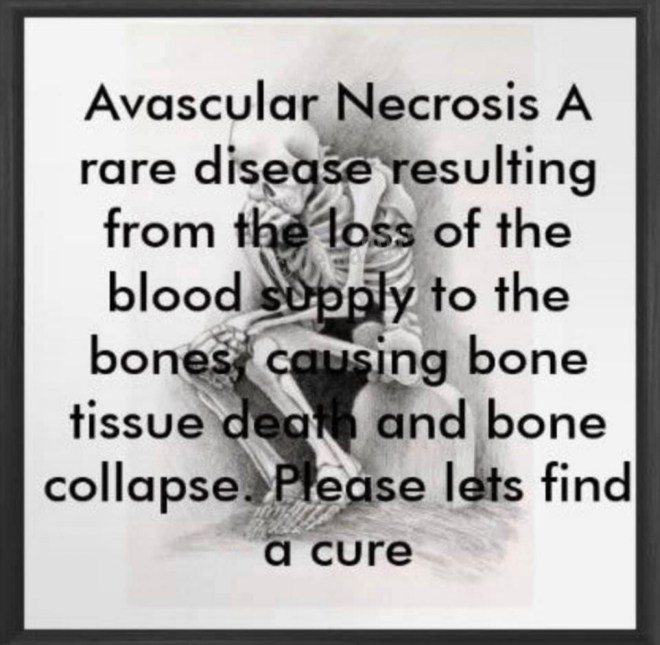
AVN-ON is a disease that results from the temporary or permanent loss of blood supply to the bone.

When blood supply is cut off, the bone tissue dies and the bone collapses. If it happens near a joint, the joint surface may collapse.

This condition may happen in any bone. It most commonly happens in the ends of a long bone. It may affect one bone, several bones at one time, or different bones at different times.

What causes avascular necrosis?

Avascular necrosis – Osteonecrosis may be the result of the following:

• Injury

• Fracture

• Damage to blood vessels

• Long-term use of medicines, such as corticosteroids

•To many steroid injections

• Excessive, long-term use of alcohol

• Specific chronic medical conditions

What are the risk factors for avascular necrosis-osteonecrosis?

Risk factors include:

• Injury

• Steroid use

• Gaucher disease

• Caisson disease

• Alcohol use

• Blood disorders, such as sickle cell anemia, factor V, eNOS, mthfr, factor viii

• Radiation treatments

• Chemotherapy

• Pancreatitis

• Decompression disease

• Hypercoagulable state

• Hyperlipidemia

• Autoimmune disease

• HIV

• Vasculitis

• Bone Marrow Edema

• Legg Calves Perthes is avn in childhood

Vasculitis

Smoking

High cholesterol

What are the symptoms of avascular necrosis?

The following are the most common symptoms of avascular necrosis. However, each person may experience symptoms differently. Symptoms may include:

• Minimal early joint pain

• Increased joint pain as bone and joint begin to collapse

• Limited range of motion due to pain

The symptoms of avascular necrosis may look like other medical conditions or bone problems. Always talk with your healthcare provider for a diagnosis.

How is avascular necrosis treated?

Specific treatment for avascular necrosis will be determined by your healthcare provider based on:

• Your age, overall health, and medical history

• Extent of the disease

• Location and amount of bone affected

• Underlying cause of the disease

• Your tolerance for specific medicines, procedures, or therapies

• Expectations for the course of the disease

Key points about avascular necrosis

• Avascular necrosis is a disease that results from the temporary or permanent loss of blood supply to the bone. It happens most commonly in the ends of a long bone.

• Avascular necrosis may be the result of injury, use of specific medicines, or alcohol.

• Symptoms may include mild to severe joint pain and limited range of motion.

• Medications,assistive devices, new experimental treatments like Prp and stem cell injections have show great promise but usually not covered by insurance or you may need to have surgery to improve functionality or to stop further damage to the affected bone or joint.

Next steps

Tips to help you get the most from a visit to your healthcare provider:

• Know the reason for your visit and what you want to happen.

• Before your visit, write down questions you want answered.

• Bring someone with you to help you ask questions and remember what your provider tells you.

• At the visit, write down the name of a new diagnosis, and any new medicines, treatments, or tests. Also write down any new instructions your provider gives you.

• Know why a new medicine or treatment is prescribed, and how it will help you. Also know what the side effects are.

• Ask if your condition can be treated in other ways.

• Know why a test or procedure is recommended and what the results could mean.

• Know what to expect if you do not take the medicine or have the test or procedure.

• If you have a follow-up appointment, write down the date, time, and purpose for that visit.

• Know how you can contact your provider if you have questions. You’re physician should always take a few minutes to talk to you and discuss concerns, treatments all treatments not just the ones they do.

If you don’t get good communication you may want to get another opinion and consider changing providers.

Learn to be your own advocate

Your worth it.

Osteonecrosis has many different causes. Loss of blood supply to the bone may lead to bone cell death and can be caused by an injury (bone fracture or joint dislocation; called traumatic osteonecrosis). At times, there may be no history of injury (non-traumatic osteonecrosis); however, other risk factors are associated with the disease such as some medications (steroids, also known as corticosteroids), alcohol usage or blood coagulation disorders. Increased pressure within the bone also is associated with osteonecrosis. One theory is that the pressure within the bone causes the blood vessels to narrow, making it difficult for blood to circulate through the bone. Osteonecrosis can also be associated with other disorders.

The exact reason osteonecrosis develops is not fully understood for some risk factors. Sometimes, osteonecrosis occurs in people with no risk factors (idiopathic).

Some people have multiple risk factors. Osteonecrosis most likely develops because of the combination of factors, possibly including genetic, metabolic, self-imposed (alcohol, smoking), and other diseases that you may have and their treatment. 

Injury:
When a joint is injured, as in a meniscus tear, fracture or dislocation, the blood vessels may be damaged. This can interfere with the blood circulation to the bone and lead to trauma-related osteonecrosis. Studies suggest that this type of osteonecrosis may develop in more than 20% of people who dislocate their hip joint. And 15 % of people who have trauma to knee.

Corticosteroid Medications:
Corticosteroids, such as prednisone, are commonly used to treat diseases in which there is inflammation, such as systemic lupus erythematosus, copd, rheumatoid arthritis, inflammatory bowel disease, and vasculitis.

Studies suggest that long-term, high dose systemic (oral or intravenous) corticosteroid use is a major risk factor for non-traumatic osteonecrosis with reports of up to 35 percent of all people with non-traumatic osteonecrosis.

However, there is still some risk of osteonecrosis associated with the infrequent use of corticosteroids, inhaled corticosteroids, or most steroid injections into joints.

Patients should discuss concerns about corticosteroid use with their doctor.

Doctors aren’t sure exactly why the use of corticosteroids sometimes is associated with osteonecrosis. They may have negative effects on different organs and tissues within the body. For example, they may interfere with the body’s ability to build new bones and to break down fatty substances.

These substances would then build up in and clog the blood vessels, causing them to narrow. This then would reduce the ability of blood to flow inside a bone.

Alcohol Use:
Excessive alcohol use is another major risk factor for non-traumatic osteonecrosis. Studies have reported that alcohol accounts for about 30% of all people with non-traumatic osteonecrosis. While alcohol can slow down bone remodeling (the balance between forming new bone and removing bone), it is not known why or how alcohol can trigger osteonecrosis.

Other Risk Factors:
Other risk factors or conditions associated with non-traumatic osteonecrosis include Gaucher disease, pancreatitis, autoimmune disease, cancer, HIV infection, decompression disease (Caisson disease), and blood disorders such as sickle cell disease, factor v, mthfr, and more so always ask your doctor to check you for a clot disorder.

Certain medical treatments including radiation treatments and chemotherapy can cause osteonecrosis. People who have received a kidney or other organ transplant may also have an increased risk.

Affected Populations

Osteonecrosis usually affects people between 20 and 50 years of age; about 10,000 to 20,000 people develop osteonecrosis each year in the United States alone.

Osteonecrosis affects both men and women and affects people of all ages. It is most common among people in their thirties and forties. Depending on a person’s risk factors and whether the underlying cause is trauma, it also can affect younger or older people.

Diagnosis

After performing a complete physical examination and asking about the patient’s medical history (for example, what health problems the patient has had and for how long), the doctor may use one or more imaging techniques to diagnose osteonecrosis. As with many other diseases, early diagnosis increases the chances of treatment success.

It is likely that the doctor first will recommend an x-ray. X-rays can help identify many causes of joint pain, such as a fracture or arthritis. If the x-ray is normal, the patient may need to have more tests.

Research studies have shown that magnetic resonance imaging (MRI) is currently the most sensitive method for diagnosing osteonecrosis in the early stages. The tests described below may be used to determine the amount of bone affected and how far the disease has progressed.

X-Ray
An x-ray is a common tool that the doctor may use to help diagnose the cause of joint pain. It is a simple way to produce pictures of bones. The x-ray of a person with early osteonecrosis is likely to be normal because x-rays are not sensitive enough to detect the bone changes in the early stages of the disease. X-rays can show bone damage in the later stages, and once the diagnosis is made, they are often used to monitor the course of the condition.

Magnetic Resonance Imaging (MRI)
MRI is a common method for diagnosing osteonecrosis. Unlike x-rays, bone scans, and CT (computed/computerized tomography) scans, MRI detects chemical changes in the bone marrow and can show osteonecrosis in its earliest stages before it is seen on an x-ray. MRI provides the doctor with a picture of the area affected and the bone rebuilding process. In addition, MRI may show diseased areas that are not yet causing any symptoms. An MRI uses a magnetic field and radio waves to produce cross-sectional images of organs and bodily tissues.

Bone Scan
Also known as bone scintigraphy, bone scans should not be used for the diagnosis of osteonecrosis because they may miss 20 to 40% of the bone locations affected.

Computed/Computerized Tomography (CT)
A CT scan is an imaging technique that provides the doctor with a three-dimensional picture of the bone. It also shows “slices” of the bone, making the picture much clearer than x-rays and bone scans. CT scans usually do not detect early osteonecrosis as early as MRI scans but are the best way to show a crack in the bone. Occasionally it may be useful in determining the extent of bone or joint surface collapse.

Biopsy
A biopsy is a surgical procedure in which tissue from the affected bone is removed and studied. It is rarely used for diagnosis, as the other imaging studies are usually sufficiently distinct to make the diagnosis with a high level of confidence.

Standard Therapies

Treatment
Appropriate treatment for osteonecrosis is necessary to keep joints from collapsing. If untreated, most patients will experience severe pain and limitation in movement within two years. There is no agreed upon optimal treatment for individuals with osteonecrosis.

Early intervention is essential to preserve the joints, but most people are diagnosed late in the disease process. 

Several treatments are available that can help prevent further bone and joint damage and reduce pain. To determine the most appropriate treatment, the doctor considers the following aspects of a patient’s disease: the age of the patient; the stage of the disease–early or late; the location and amount of bone affected–a small or large area. The underlying cause has not been shown to influence outcomes of treatment.

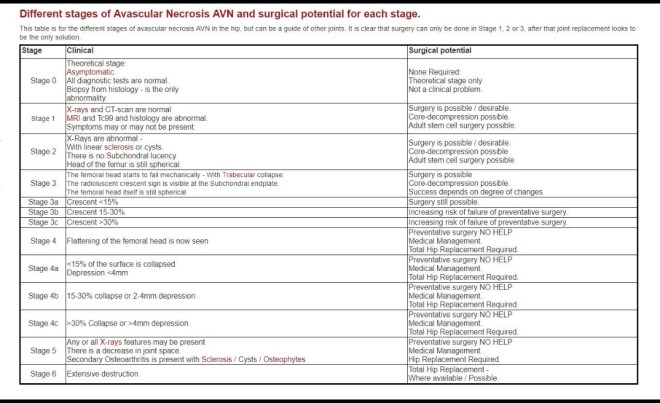
The goal in treating osteonecrosis is to improve the patient’s use of the affected joint, stop further damage to the bone, and ensure bone and joint survival. If osteonecrosis is diagnosed early enough, collapse and joint replacement can be prevented. To reach these goals, the doctor may use one or more of the following treatments.

Non-operative Treatment

There is no known pharmaceutical cure for osteonecrosis. Several non-operative treatments have been studied including hyperbaric oxygen therapy, shock wave therapy, electrical stimulation, pharmaceuticals (anticoagulants, bisphosphonates, vasodilators, lipid lowering agents), physiotherapy and muscle strengthening exercises, and combinations thereof. There are conflicting results for some of these treatments, therefore, rigorous, randomized controlled trials with large numbers of patients are still needed to determine the effectiveness of these treatments. Non-operative treatment may be part of a wait-and-see approach based on the size of the area of dead bone. Non-operative treatments cannot be labeled as conservative, since many of them do not slow the progression of the disease or lead to avoidance of a total hip arthroplasty. Most are simply pain-relieving at best.

Reduced weight bearing does not alter the course of the disease and is not a treatment. It may be used to simply permit the patient to better cope with pain until appropriate treatment is instituted. 

Surgical Treatment

Core decompression – This surgical procedure removes or drills a tunnel into the area of the affected bone, which reduces pressure within the bone. Core decompression works best in people who are in the earliest stages of osteonecrosis, before the collapse of the dead bone. This procedure sometimes can reduce pain and slow the progression of bone and joint destruction in these patients.

Osteotomy – This surgical procedure reshapes the bone to reduce stress on the affected area. There is a lengthy recovery period, and the patient’s activities are very limited for 3 to 12 months after an osteotomy. This procedure is most effective for patients with advanced osteonecrosis and those with a small area of affected bone.

Bone graft – Bone grafts can be used as part of the surgical treatment for osteonecrosis. Bone grafts can use bone from the same patient or donor bone. Bone graft or synthetic bone graft can be inserted into the hole created by the core decompression procedure. A specialized procedure, called vascularized bone grafting, involves moving a piece of bone from another site (often the fibula, one of the bones of the calf, or the iliac crest, a portion of the pelvic bone) with a vascular attachment. This allows for support of the diseased area as well as a new source of blood supply. This is a complex procedure and is performed by surgeons that are specially trained. Another type of bone grafting, involves scraping out all of the dead bone and replacing it with healthier bone graft, often from other portions of the patient’s skeleton. 

A unique type of bone graft involves the use of a patient’s own cells that are capable of making new bone. Often these cells are a type of stem cell from the bone marrow or other bodily tissues. There has been increasing interest in the potential of stem cell therapy. This is also being studied for the treatment of osteonecrosis. Mesenchymal stem cells, which are a type of ‘adult’ stem cell, can grow and develop into many different cell types in the body. Physicians take the patient’s own mesenchymal stem cells (autologous transplant) and place them into the affected bone to stimulate bone repair and regeneration.

Arthroplasty/total joint replacement – Total joint replacement is the treatment of choice in late-stage osteonecrosis when the joint is destroyed. In this surgery, the diseased joint is replaced with artificial parts. It may be recommended for people who are not good candidates for other treatments, such as patients who do not do well with repeated attempts to preserve the joint. Various types of replacements are available, and people should discuss specific needs with their doctor.

For most people with osteonecrosis, treatment is an ongoing process. Doctors may first recommend the least complex and invasive procedure, such as protecting the joint by limiting high impact activities, and watch the effect on the patient’s condition.

Other treatments then may be used to prevent further bone destruction and reduce pain such as core decompression with bone graft/stem cell therapy,Prp injections, A2m injection. But some of these new treatments may not be covered by your insurance.

Eventually patients may need joint replacement if the disease has progressed to collapse of the bone. It is important that patients carefully follow instructions about activity limitations and work closely with their doctor to ensure that appropriate treatments are used.

Investigational Therapies

Scientists, researchers, and physicians continue to pursue a better understanding of how this disease occurs as well as compare the effectiveness of current and newly developed therapies. Often, this requires a clinical trial to answer questions and gain additional knowledge.

Information on current clinical trials is posted on the Internet at www.clinicaltrials.gov. All studies receiving U.S. government funding, and some supported by private industry, are posted on this government web site.

Information

Stem Cell

Alcohol and Osteonecrosis

Osteonecrosis Knee

Various Links Osteonecrosis

Material Used In Hip Replacements

The Many Different Materials Used in Hip Replacement Devices.

If you need a hip replacement it’s best to educate yourself .

Hip replacement devices break into a few big categories:

Metal on Metal (MOM) – These are what they sound like. Both the socket and the ball are made of stainless steel, titanium, chromium, cobalt or some combination of these. One sub-type of a MOM hip is a minimally invasive model which usually is smaller in size, so it can be installed with a smaller incision.

Polyethylene and Metal on Polyethylene (MOP) – Polyethylene is basically plastic, so these hips usually have metal structural pieces and a plastic liner where the ball and socket meet. They can also have a metal ball meeting a plastic socket liner. A sub-type of a polyethylene hip is made with a newer plastic called cross linked polyethylene, which is more durable.

Ceramic on Metal (COM), Ceramic on Ceramic (COC), Ceramic on Polyethylene (COP) – Ceramic hips are made of specialized and more durable versions of the same type of material that plates and bowls are made from. There are ceramic on metal, ceramic on ceramic, and ceramic on polyethylene versions. While these are durable, they can be vulnerable to fracture and breaking under big stresses.

Wear Particles

If for some reason I would need a hip replacement, my single biggest concern would be wear particles. This phenomenon first came to light about 5 – 7 years ago when surgeons began to replace the first worn out or failed metal on metal (MOM) hips. What they found in some patients was scary. Basically, the entire area directly around the hip replacement device had turned into a mass of black goo.

Then studies were published showing that those microscopic metal shavings were leaching into the blood stream and causing elevated metal ion levels. Additional studies began to point out that some people’s tissue was so sensitive to this junk that they formed pseudotumors, which are basically big solid masses of irritated tissues, some of which could press on important nerves. Finally, genetic studies showed that not only was this tissue visibly unhappy, the cells were getting damaged at a genetic level from the wear particles.

When all of this first came to light, it looked like only MOM hips were involved. However, as the research below shows, the issue of wear particles extends to every type of hip made.

ARMD – Adverse Reactions to Metal Debris

Before we begin, it’s worth noting that there is now a name for pissed off tissue caused by wear particles. In a 90s movie, a nuclear war head falls into the wrong hands and the main character is informed that this is called a “Broken Arrow”. He responds to the effect of, “I’m not sure what’s more disturbing, the fact that we just lost a nuclear warhead or that you actually have a name for this”. I feel the same about the fact that the orthopedic joint replacement community now has a name for wear particles that cause problems in patients.

In addition to highlighting research on wear particles, I’ll also look at the durability of each type. So let’s take a look at how to navigate this minefield.

The Research on the Various Types of Hip Replacement Materials – Focused on Wear Particles and Device Failure

MOM or “Metal on Metal”

The “bad boy” of hip replacement types is clearly MOM hips. The funniest thing is that despite all of the absolutely horrific things published about these devices, you can still find Internet ads for many surgeons who will be happy to implant them. They do this by claiming that these are “minimally invasive” hips. While there’s a tiny kernel of truth in that hogwash (the incisions needed to implant them are smaller), there is nothing minimally invasive about amputating a joint and inserting a prosthesis, no matter how you skin that cat. In addition, the smaller the device, the bigger the wear particle issue.

MOM hips produce metal wear particles locally that are then taken up in the bloodstream. In general, smaller MOM hip devices (usually those used for small framed women) have a higher likelihood of producing metal wear particles. This study showed more metal ions in the blood with MOM devices compared to conventional hip replacement prostheses. This randomized trial again demonstrated more metal ions in the blood of women with MOM hips when compared to conventional hip replacement, but also noted that pseudotumors occurred both around these MOM devices and the more conventional MOP devices as well. This recent study showed that metal debris was present in both large and small MOM hip replacement devices.

Photo from Breaking Muscle It’s all in the hips

The latest 2015 consensus guidelines are now not to perform a MOM hip replacement in small women or anybody with a known metal allergy. The latest study on MOM hips and pseudotumors concludes, “Adverse reactions to metal debris in MOM hips may not be as benign as previous reports have suggested.” Not good.

Polyethylene and Metal on Polyethylene (MOP)

When I initially began this literature search, I thought that MOP hips may be better in the wear particle department. After all, you don’t have metal rubbing on metal, but usually metal on plastic. However, I was wrong.

To see how bad things can get with MOP wear particles, I didn’t have to look far. This recent study from 2014 showed an awful side effect of both polyethylene and metal wear particles, a pseudotumor that invaded a woman’s vaginal tissues. This 2015 study was very concerning in that it compared MOP hips to MOM hips with regard to metal levels and chromosome damage in cells. It couldn’t conclude that one was better than the other. Based on this 2014 study, MOP hips wear less, but their wear particles produce slightly more tissue reaction than MOM hips. This is all consistent with a recent study I blogged on, showing that conventional polyethylene wear particles reduced stem cell activity in bone marrow and muscle.

If there is one bright spot in this category, it’s likely the newer highly cross linked polyethylene (HCLP). Based on this recent study, HCLP hips produced fewer wear particles than regular polyethylene. In another study of shoulder replacement devices, the lower debris for these devices was confirmed. In addition, based on this 2014 study HCLP devices seem to withstand unexpected wear and part failure better.

Ceramic on Metal (COM), Ceramic on Ceramic (COC), Ceramic on Polyethylene (COP)

Maybe ceramic is the way to go? After all, what could go wrong with installing a hip replacement device made of the same substance as dinner plates?

This 2015 randomized trial showed that COM hips still regrettably produced metal wear particles that ended up in the blood stream. Some good news for COM hips could be found in this 2015 study. It concluded that while there was swelling around these devices, when compared to minimally invasive MOM hips, there were no pseudotumors seen in COM hips. However, based on this analysis of many studies, there doesn’t seem to be any advantage of COC compared to COP. How does COM and COC compare? Ceramic on metal doesn’t seem to have the same durability as ceramic on ceramic based on this study.

Is Your Surgeon Being Paid to Promote a Certain Type of Hip?

One of the real challenges in navigating this landscape is that regrettably, joint replacement devices have been one of the worst areas of payola in medicine. As reimbursements have declined for the surgical procedures of installing and replacing devices, many surgeons have figured out that they can keep their cash flow stable by taking money from the device manufacturers. This has been the subject of many Department of Justice lawsuits through the years.

The big issue for patients is how to know if their surgeon is recommending a hip device because they really feel that it’s the best, or because they’re getting paid by the company making the device. This Propublica web-site will allow you to research your surgeon’s payment history.

Correct Sizing is Key!

It’s very clear from reviewing the medical research on this topic that a poorly sized hip device is a huge problem for many reasons. First, it will reduce the longevity of the device. Perhaps more importantly, it virtually guarantees more harmful wear particles. And since we’re talking about replacing your hip, a good fit is common sense.

Given the modular nature of these hip devices and the wide array of options, a poor fit should never happen. However, in my experience, hardware fitting issues usually happen when the operating room and/or hospital don’t have the correct size in stock on the day of the surgery. So agree before hand on the size of the components and make sure the staff has double-checked to make sure the hospital has that size in stock.

The upshot? All hip replacement devices produce wear particles. But which is best? It’s clear that when metal on metal implants go bad, things can go very bad with a local tissue reaction that can cause pseudotumors and high metal ions levels in the blood. If I had to get my hip replaced, I would cross this type of implant off my list. Ceramics still produce wear particles and have the added problem of fracturing in an active individual. Polyethylene wear particles in a MOP hip can be just as bad as those from a MOM hip. Given that highly cross linked polythylene has the least wear particles, this is likely the winner. However, realize that not as much is known about tissue reaction to cross linked polyethylene, so that recommendation may change with time. In addition, there are newer types of ceramics that once mated with HCLP could produce less debris.

More information Hip Replacement Material- Regenexx

Hip Replacement

FDA on Hip Replacement Parts

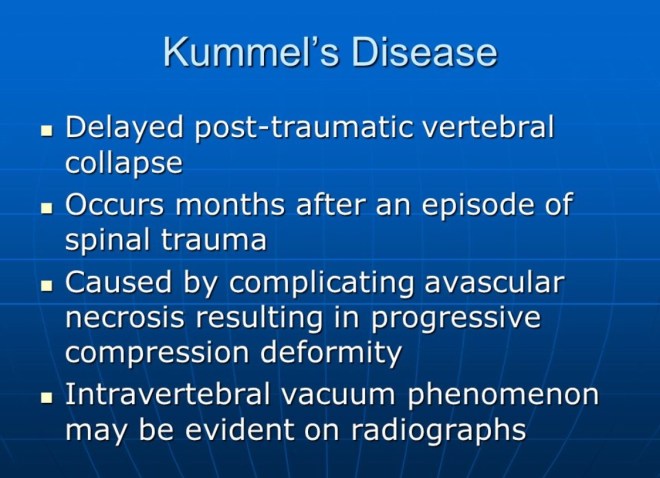
Kummel Disease

Avascular necrosis (AVN) develops when a bone loses its blood supply. AVN goes by several other names, including Kummel disease, osteonecrosis, aseptic necrosis, and ischemic bone necrosis. AVN typically affects bone in the hips, thighs, knees and shoulders—although it can develop in any bone in the body.

Kummel disease is a rarely occurring variation of avascular necrosis that can affect the spine’s vertebrae, usually the thoracic spine (mid back) region. There are many different spine-related disorders that can contribute to disrupting a vertebral body’s blood supply, such as infection, osteoporosis, radiation therapy, steroid use, and metastatic spine tumors. Like other organs in the body, bone needs a healthy blood supply to rebuild itself, stay strong and support the spinal column.

Though Kummell disease is rare, researchers believe it’s becoming more prevalent as the aging population grows. People with osteoporosis and older adults are at a greater risk for developing this disorder.

Kummel Disease: A Not-So-Rare Complication of Osteoporotic Vertebral Compression Fractures

As our population ages, the prevalence of osteoporosis, its most common fragility fracture (vertebral compression fracture), and Kummel disease will increase.

Also if younger and you are diagnosed with osteoporosis your chances are higher to possibly develop Kummel Disease.


text ©Debla2017

Avascular Necrosis and Kummel Disease Share Some Similar Causes and Risk Factors

  • Injury: This is known as trauma-related avascular necrosis. A broken hip or vertebral fracture may lead to osteonecrosis.
  • Increased pressure within the bone: The pressure within the bone causes the blood vessels to narrow, making it hard for the vessels to deliver enough blood to the bone cells.
  • Certain risk factors: This is known as non-traumatic avascular necrosis. These risks include medical conditions and lifestyle choices that affect bone metabolism or bone remodeling.

AVN has several risk factors, including medical conditions and lifestyle choices that may increase your chances of developing the disorder:

  • Heavy alcohol use
  • Long-term corticosteroid use
  • Osteoporosis
  • Blood clots and arterial inflammation
  • Blood disorders (such as Sickle cell disease)
  • Radiation and chemotherapy
  • Pancreatitis
  • Gaucher disease (occurs when high amounts of fatty substances collect in the organs)
  • Decompression sickness (a condition causing gas bubbles in the blood)

How Doctors Diagnose Avascular Necrosis 

Diagnosing spinal AVN caused by trauma—also called Kummell disease—begins with a thorough review of your medical history and symptoms. This is all part of your physical exam.

After your physical exam, your doctor may order imaging scans to better see changes in your vertebrae.

Below are some of the tools your doctor may use to diagnose Kummell disease:

  • X-ray: This first-line imaging test can illuminate problems with your spinal bones. It’s not able to show early-stage bone problems, though.
  • Computed tomography (CT) scan: A CT scan provides a 3-dimensional picture of your bone. It also shows “slices” of bone, making the picture clearer than what x-rays and bone scans deliver.
  • Magnetic resonance imaging (MRI): This technology can produce very detailed images of your soft tissues and bones. The test is sensitive enough to see bone problems at their earliest onset, which x-ray is unable to do.
  • Bone scan: Also known as skeletal scintigraphy, bone scans are often used in people who have normal x-rays. A radioactive dye is injected into your affected bone and a picture of your bone is taken with a special camera. The picture shows how the dye travels through your bone and where normal bone formation is occurring.
  • Biopsy: A biopsy is a surgical procedure in which tissue from your affected bone is removed and studied. Although a biopsy is a conclusive way to diagnose AVN, it is rarely used because it requires surgery.
  • Functional evaluation of bone: Tests to measure the pressure inside a bone may be used when your doctor strongly suspects that you have AVN, despite normal x-ray, bone scan, and MRI results. These tests are very sensitive at detecting increased pressure within your bone, but they require surgery.

How Is Avascular Necrosis Treated?

The goals of treatment for AVN include improving your use of the affected joint, stopping further damage to the bone, and ensuring bone and joint survival.

If you have an early-stage form of Kummell disease, your doctor may prescribe medications to manage pain and/or inflammation. Physical therapy (PT) may be included in your treatment plan. A physical therapist can teach you how to exercise safely to protect your joints and bones while building strength, flexibility and endurance.

Though non-surgical treatments may help keep pain at bay, they are generally a temporary solution for people with Kummel disease. In many cases, spine surgery is necessary to prevent the condition from progressing to a point that it harms your quality of life.

Spine surgery for Kummel disease may have several purposes, depending on your specific symptoms. As such, your surgeon may use a single surgical approach or combine techniques to give you the best possible outcome. For example:

  • If you have developed abnormal kyphosis, your doctor may recommend osteotomy (surgical removal of bone) combined with spinal instrumentation and fusion. This combination of surgical procedures can reduce the size of the kyphotic curve, realign the spine and stabilize it.
  • Some patients with Kummel disease have pain and neurological symptoms, such as numbness or weakness. If symptoms are caused by nerve compression, a spinal decompression surgery (such as a foraminotomy) may be recommended to relief pressure on pinched nerves and prevent potentially permanent nerve damage.

Another surgical option for AVN is known as core decompression. This procedure involves removing the inner layer of bone, which reduces pressure within the bone, increases blood flow to the bone, and allows more blood vessels to form.

Core decompression works best in people who are in the earliest stages of avascular necrosis, often before the collapse of a joint. This procedure may reduce pain and slow progression of bone and joint destruction.

After core decompression, your surgeon may implant bone graft to help stimulate new bone growth and healing. Bone graft transplants healthy bone from a part of the body, such as the leg, to the diseased area. Several synthetic bone grafts are also available. Depending on the location and extent of the surgery, expect a lengthy recovery period, usually from 6 to 12 months.

As with all areas of medicine, researchers are continuously exploring treatments that may help people with AVN. One area of interest is therapies that increase the growth of new bone and blood vessels. These treatments have been used experimentally alone and in combination with other treatments, such as osteotomy and core decompression.

Your doctor will work with you to develop a custom treatment plan that addresses your symptoms and medical history.

Your Outlook with Avascular Necrosis (Kummel Disease)

For most people with avascular necrosis (also known as osteonecrosis, aseptic necrosis, and ischemic bone necrosis), treatment is an ongoing process. Your doctor may first recommend the least invasive approach and observe how you respond before progressing you to more substantial AVN therapies. If your condition affects your spinal vertebrae and was caused by trauma or injury (Kummell disease), several treatments may help prevent complications like spinal fracture, kyphosis deformity, and nerve pain from disrupting your life.

Tired of Doctors? I am also.

If you are like me,your sick of seeing doctors , some see so many my heart breaks for them, pcp, orthos, hematologist, cardiologists, pain management, endocrinologist dentists, optometrist whatever it just gets tiring. then you might get so nervous at your appointment you forget to ask specific questions.

Or maybe your anxiety has gotten you to a place where your heart is beating out of your chest, and your voice quivers or you just become blank.

Either way, having a list of things you mean to ask will help not only you but your doctor be able to better communicate.

So here we go:

1. What is the exact name of whatever is wrong with me? 1a if Osteonecrosis what stage is it? 1-2-3-4-5-5a-6

2. Is this something that is treatable and may possibly go away, or heal on its own or is this something that is chronic?

3. What are the short-term and long-term prognoses?

4. What are the short-term and long-term goals with treatment?

Example : Prp injections- physical therapy- hyperbaric oxygen-water therapy- stem cell treatments- joint replacement .

5. Is this something that genetically I can pass down to my child(ren)?

5a. Will you check me for underlying clot issue like Factor V Leiden-MTHFR-eNOS

6. What do you recommend as far as treatment?

7. What are the medications you recommend? I heard and read statins like Zocor and Lipitor can help lower lipids (fat) in the blood which can help blood flow better. I personally took simvastatin for 6 m and it helped me. I also during that time changed how I ate to consume less fatty meat cheeses etc

To lower my cholesterol on my own and I must say I am grateful I tried this.

Not only do I love eating REAL food but my blood work shows fantastic results and my pain is less.

So it’s good to talk to your doctor about this stuff also. Of course your doctor is not a specialist in nutrition which is kinda sad , you’d think they would teach that in medical school. But a good plant based diet was a great change for me.


8. How will this condition and/or medications affect my life?

9. Is there a specialist I can see? So I may try to avoid a joint replacement?

10. Will this condition or medications affect my ability to exercise? Walk-Bike- Swim.

Will this be temporary?

11. Is there a special diet that might ease symptoms or improve this condition?

For me personally it is plant based. I will eat meat (beef) rarely . Chicken or fish 1x a week but I am all about plant based.

My pain is lessened by over 60percent. I still have pain I’m not cured but I’m not in constant misery anymore. I rarely take a pain pill.

Never start or stop anything without talking to your doctor.

As always, if you have any concerns about your health, it’s always best to consult your primary care physician.

~~~~~~~~~~~~~~~~~~~~~~~~~~~~~~~~~~~~~~~~~~~~~~~~~~~~~~~~~~~~~~~~~~~~~~~~~~~~~~


Specific Questions To Ask Your Otho

What stage is osteonecrosis?
Will I be checked to make sure it also is not affecting other joints since I have pain in other bones/joints?
What is your treatment plan for Osteonecrosis ?
Why is this procedure being recommended? Are there alternatives?
What are the benefits of this procedure in terms of pain relief, functioning/mobility? How long will the benefit last?
What are the risks involved?
What is the success rate for this procedure?
What is the procedure called? How is it done?
How many patients with osteonecrosis do you see a year?
If Surgery Will this surgery solve the problem? Will any more surgery be required in the future?
How many of these procedures are annually performed at this hospital?
How many patients with osteonecrosis do you see a year?
What percentage of patients improve following the procedure?
What will happen if I don’t have the surgery now?
If I want a second opinion, whom can I consult?
Will I need any tests or medical evaluations prior to the surgery?
What kind of anesthesia will be used?
Are there possible after effects or risks?
Will I meet with the anesthesiologist in advance? Will her or she know my needs/allergies?
What kind of implant or prosthesis will be used? What are the outcomes using this device?
How long will it last?
Will I have pain following the procedure? What pain relief or pain control measures will I be given?
How long will the recovery take? What are my limitations during recovery?
Will I need assistance at home afterwards? For how long?
What will discharge instructions be?
Will I have any disability following surgery? Will I need physical therapy?
When can I return to work? When can I drive my car? When can I have sexual activity?
Are there any materials about this surgery that I can review?
What will I have for pain management?
Are their any patients I can ask about their experience?


Here is some info you may be interested in.

Clinical Trials

Atorvastatin to Prevent Avascular Necrosis of Bone in Steroid Treated Exacerbated Systemic Lupus Erythematosus

https://clinicaltrials.gov/ct2/show/NCT00412841

Statin therapy decreases the risk of osteonecrosis in patients receiving steroids.

https://www.ncbi.nlm.nih.gov/m/pubmed/11347831/

Aseptic osteonecrosis of the hip in the adult: current evidence on conservative treatment

https://www.ncbi.nlm.nih.gov/pmc/articles/PMC4832407/

Steinberg Stages Of Osteonecrosis-Avascular Necrosis

Steinberg Staging Of Avascular Necrosis/ Osteonecrosis

History and etymology

It is based on the radiographic appearance and location of lesion. It primarily differs from the other systems by quantifying the involvement of femoral head which allows direct comparison between series1. Seven stages of involvement are identified. Following staging, extent of involvement of femoral head is recorded as mild, moderate or severe.

Classification

stage 0: normal or non-diagnostic radiographs, MRI and bone scan of at risk hip (often contralateral hip involved, or patient has risk factors and hip pain)

stage I: normal radiograph, abnormal bone scan and/or MRI

stage II: cystic and sclerotic radiographic changes

stage III: subchondral lucency or crescent sign

stage IV: flattening of femoral head, with depression graded into

mild: <2 mm

moderate: 2-4 mm

severe: >4 mm

stage V: joint space narrowing with or without acetabular involvement

stage VI: advanced degenerative changes

Quantification of extent of involvement is necessary for stages I to V:

stage I and II

A, mild: <15% head involvement as seen on radiograph or MRI

B, moderate: 15% to 30%

C, severe: >30%

stage III

A, mild: subchondral collapse (crescent) beneath <15% of articular surface

B, moderate: crescent beneath 15% to 30%

C, severe: crescent beneath >30%

stage IV

A, mild: <15% of surface has collapsed and depression is <2mm

B, moderate: 15% to 30% collapsed or 2 to 4mm depression

C, severe: >30% collapsed or >4mm depression

stage V

A, B or C: average of femoral head involvement, as determined in stage IV, and estimated acetabular involvement.

Steinberg Staging Osteonecrosis

See also

Avascular Necrosis Of The Hip

Fixated and Arlet Staging

Legg-Calvé Perthes Disease

AVN CharityUK

References

1. Steinberg ME, Hayken GD, Steinberg DR. A quantitative system for staging avascular necrosis. J Bone Joint Surg Br. 1995;77 (1): 34-41. Pubmed citation

Terminology

I have taken the time to list all the jargon on avn-on

Medical Definition of Avascular necrosis

Avascular necrosis: A condition in which poor blood supply to an area of bone leads to bone death. Abbreviated AVN. Also known as aseptic necrosis and osteonecrosis.

avascular necrosis Death of a tissue, especially bone, as a result of deprivation of its blood supply. Avascular necrosis of bone is often referred to as osteonecrosis.

Medical Definition of avascular

: having few or no blood vessels the lens is a very avascular structure avascular necrosis

Necrosis is

The death of cells, tissues, or organs. Necrosis may be caused by insufficient blood supply, pathogenic microorganisms, physical agents such as trauma.

superficial necrosis

Necrosis affecting only the outer layers of bone or any tissue.

coagulation necrosis

Also found in: Dictionary, Thesaurus, Legal, Encyclopedia.

Related to coagulation necrosis: coagulative, liquefaction necrosis, Necrotic tissue

necrosis [nĕ-kro´sis, ne-kro´sis] (Gr.)

the morphological changes indicative of cell death caused by enzymatic degradation.

aseptic necrosis necrosis without infection or inflammation.

central necrosis necrosis affecting the central portion of an affected bone, cell, or lobule of the liver.

Links


Glossary of terms used in  Avascular Necrosis –Osteonecrosis

Acetabulum – In the pelvis the hip socket is called the acetabulum and forms a deep cup that surrounds the ball or femoral head of the upper thigh bone.


Acute pain – Pain that is rapid to develop, and for a shorter duration than Chronic pain.

Ref – Wikipedia


Analgesic – A member of a group of drugs to give relief from pain.


Arthroplasty – Surgical repair of  joint., also referred to as joint replacement. The affected bone is removed and replaced with an artificial joint. This treatment may be needed in the late stages of AVN, or when a joint has collapsed.


Articular cartilage – White smooth tissue that covers the ends of bones in joints. It enables bones in a joint to glide over one another with very little friction, allowing easy movement. See Cartilage


Aseptic Necrosis – Another name for Avascular Necrosis or Osteonecrosis.


Asymptomatic – A disease is considered Asymptomatic if a patent is a carrier for a disease or infection but experiences no symptoms. A condition might be considered Asymptomatic if it fails to show the noticeable symptoms of which it is usually associated. The term clinically silent is also used.


Atherosclerosis – Condition in which an artery wall thickens as a result of the accumulation of fatty materials such as cholesterol.

Ref – Wikipedia


Avascular – Having few or no blood cells.

Ref – Encyclopaedia Britannica


Bone Marrow Edema – Only cited since 1988 after the introduction of MRI scans – is bruising of the bone or additional fluid (water) content in the bone marrow. This condition often accompanies avascular necrosis. On the MRI image it is shown as light areas of the bone which should be seen as dark.


Bone Infarct – Bone Infarct is another name for osteonecrosis . It’s a more descriptive term for what has happened, a blockage of blood circulation leading to the death of part of the bone.


Bilaterally –  avascular necrosis  in both sides -in both hips, or both knees etc.


BRONJ – Biphosphonate-Related OsteoNecrosis of the Jaw (BRONJ). This usually only occurs in people receiving high dose intravenous biphosphonate injections for bone cancers, and is often associated with a dental operation. If taking biphosphonates it is important to inform your dentist and to take extra care with dental hygiene.


Cartilage – Flexible tissue between the joint bones. It is not as hard and rigid as bone, but is stiffer and less flexible than muscle.


Caisson disease – Name given to a variety of symptoms suffered by a person exposed to a reduction in the pressure surrounding their body. Typically it occurs when a person subjected to great atmospheric pressure suddenly has that pressure removed – as when a scuba diver returns rapidly to the surface after a long submerged period.  Also known as Barotrauma.


Chronic pain – This is pain that has lasted for a long time, the distinction between acute and chronic pain has traditionally been determined as Acute pain lasts for 30 days while Chronic pain last much longer.


Condyle – Smooth surface area at the end of a bone forming part of a joint with another bone.


Corticosteroid – Corticosteroids, more often known as steroids, are an anti-inflammatory medicine prescribed for a wide range of conditions.

Diabetes – A group of diseases in which a person has high blood sugar, either because the body does not produce enough insulin, or because cells do not respond to the insulin that is produced. This high blood sugar produces the classical symptoms of frequent urination, increased thirst and increased hunger.


Diaphysis – Shaft of the bone.


Distal – The more (or most) distant of two (or more) things. For example, the distal end of the femur (the thigh bone) is the end down by the knee; the end more distant from the torso.


Ellipsoidal – Joint that can move in two planes, example wrist and ankle.


Endothelial NOS (eNOS), also known as nitric oxide synthase 3 (NOS3) or constitutive NOS (cNOS), is an enzyme that in humans is encoded by the NOS3 gene located in the 7q35-7q36 region of chromosome 7.[5] This enzyme is one of three isoforms that synthesize nitric oxide (NO), a small gaseous and lipophilic molecule that participates in several biological processes.[6][7] The other isoforms include neuronal nitric oxide synthase (nNOS), which is constitutively expressed in specific neurons of the brain[8] and inducible nitric oxide synthase (iNOS), whose expression is typically induced in inflammatory diseases.[9] eNOS is primarily responsible for the generation of NO in the vascular endothelium,[10] a monolayer of flat cells lining the interior surface of blood vessels, at the interface between circulating blood in the lumen and the remainder of the vessel wall.[11] NO produced by eNOS in the vascular endothelium plays crucial roles in regulating vascular tone, cellular proliferation, leukocyte adhesion, and platelet aggregation.[12] Therefore, a functional eNOS is essential for a healthy cardiovascular system.


Epiphysis – Ends of the bone.


Factor V (pronounced factor five) is a protein of the coagulation system, rarely referred to as proaccelerin or labile factor. In contrast to most other coagulation factors, it is not enzymatically active but functions as a cofactor. Deficiency leads to predisposition for hemorrhage, while some mutations (most notably factor V Leiden) predispose for thrombosis.

Factor VIII (FVIII) is an essential blood-clotting protein, also known as anti-hemophilic factor (AHF). In humans, factor VIII is encoded by the F8 gene. Defects in this gene result in hemophilia A, a recessive X-linked coagulation disorder


Femoral head – The ball at the upper end of the thigh bone that sits inside the hip socket or acetabulum.


Gaucher’s disease – A disease in which a fatty substance accumulates in cells and certain organs. Symptoms may include enlarged spleen and liver, liver malfunction, skeletal disorders and bone lesions that may be painful, severe neurologic complications, swelling of lymph nodes and (occasionally) adjacent joints, distended abdomen, a brownish tint to the skin, anemia, low blood platelets and yellow fatty deposits on the white of the eye. Persons affected most seriously may also be more susceptible to infection.


Gout – Condition usually characterized by recurrent attacks of acute inflammatory arthritis – a red, tender, hot, swollen joint. The joint at the base of the big toe is the most commonly affected (approximately 50% of cases). It is caused by elevated levels of uric acid in the blood which crystallizes, and the crystals are deposited in joints, tendons, and surrounding tissues.

Idiopathic – An adjective used primarily in medicine meaning arising spontaneously or from an obscure or unknown cause.

In Greek; Idios translates to one’s own and Pathic translates to suffering or disease; so together becomes “a disease of it’s own” or “it comes from nothing” and medical jargon for “we don’t know what the cause is”.


Infarct – Bone infarct is another name for AVN. It’s a more descriptive term for what has happened, a blockage of blood circulation leading to the death of part of the bone.


Ischemic – Restriction in blood supply to tissue, causing a shortage of oxygen and glucose needed to keep tissue alive.


Legg Perthes disease – Avascular Necrosis in young children and can lead to Osteoarthritis in adults, also known as Calve Perthes or Perthes Disease


Lesions – Any abnormality in the tissue of an organism, for AVN we mean the bone structure at the joint site has started to break away. Usually caused by disease or trauma. Lesion is derived from the Latin word laesio which means injury.


Ligaments – Fibrous tissue that connects bones to other bones.


Medial Condyle – Inner side of the lower extremity of the femur (thigh), see Condyle.


MRI – Magnetic Resonance Imaging, is a medical imaging technique used in radiology to visualise internal structures of the body in detail. MRI makes the use of the property of nuclear magnetic resonance (NMR) to image nuclei of atoms inside the body.


MRI provides good contrast images between the different soft tissues inside the body, which makes it especially useful in imaging the brain, muscles, heart and cancers; compared with other medical imaging techniques such as computed tomography (CT) or X-rays. Unlike CT scans or traditional X-rays, MRI does not use ionizing radiation.


MTHFR is an enzyme that adds a methyl group to folic acid to make it usable by the body. The MTHFR gene produces this enzyme that is necessary for properly using vitamin B9. This enzyme is also important for converting homocysteine into methionine, which the body needs for proper metabolism and muscle growth and which is needed for glutathione creation . The process of methylation also involves the enzyme from the MTHFR gene, so those with a mutation may have trouble effectively eliminating toxins from the body.


Multifocal – Having many focal points. With regard to avascular necrosis AVN it means that it has affected many different joints in the body,. For example the hips, shoulders, knees and jaw.


Multilateral – Having many focal points. With regard to avascular necrosis AVN it means that it has affected many different joints in the body,. For example the hips, shoulders, knees and jaw.


Necrosis – Death of living tissue.


Oedema – also known as edema – Bone marrow oedema occurs when excess fluid build up in the bone marrow and causes swelling. Caused by the bodies reaction to a trauma or other condition. Symptoms are pain and/or swelling at the bone site.


Osteoarthritis –  degradation of a joint from partial loss of cartilage and damage to the bone joint surface.


Osteonecrosis – Another name for Avascular Necrosis.


Osteoradionecrosis ORN – Another name for Avascular Necrosis caused by radiotherapy.


Osteopenia – Condition where bone mineral density is lower than normal. It is considered by many doctors to be a precursor to osteoporosis. However, not every person diagnosed with osteopenia will develop osteoporosis.


Osteophytes – Commonly referred to as bone spurs, they are bony projections that form along the joint margins.


Osteoporosis – Condition of fragile bones.


Osteotomy – Osteotomy surgery involves cutting and re-aligning the bone (usually shin bone/tibia) in order to re-distribute the weight going through the knee. Re-alignement can be achieved by either taking a slice of bone out of the tibia (shin bone) or femur (thigh bone) close to the knee joint (closing wedge) or opening a gap in the bone (opening wedge).

A hip osteotomy is a surgical procedure in which the bones of the hip joint are cut, reoriented, and fixed in a new position. Healthy cartilage is placed in the weight-bearing area of the joint, followed by reconstruction of the joint in a more normal position.


Perthes disease – Avascular Necrosis (AVN) in young children and can lead to Osteoarthritis in adults also known as Legg Calve Perthes or Calve Perthes Disease.


Sacrum – Large triangular bone at the base of the spine and at the upper and back part of the pelvic cavity.


Sagittal – Imaginary line, used in MRI scans.


Sclerosis – Osteosclerosis, condition where bone density is significantly increased.


Sickle cell disease Sickle cell disease is a group of disorders that affects haemoglobin, the molecule in red blood cells that delivers oxygen to cells throughout the body. People with this disorder have atypical haemoglobin molecules called haemoglobin S, which can distort red blood cells into a sickle, or crescent, shape.


Signs and symptoms of sickle cell disease usually begin in early childhood. Characteristic features of this disorder include a low number of red blood cells (anaemia), repeated infections, and periodic episodes of pain. The severity of symptoms varies from person to person. Some people have mild symptoms, while others are frequently hospitalised for more serious complications.


SPONK – SPontaneous OsteoNecrosis of the Knee, a type of AVN or osteonecrosis specifically of the knee, either femur or tibia, and spontaneous means it occurred without an obvious cause


Subchondral – Below the cartilage.


Systemic lupus erythematosus – (SLE), often known just as lupus, is an autoimmune disease where your immune system produces antibodies that attack your body’s own tissues, causing inflammation. Lupus usually affects your skin and joints, but it may also involve your heart or kidneys, when the effects can be severe. SLE isn’t the same as discoid lupus, which only affects the skin.


Synovial – Synovial tissue is found around the tendons (bands of fibre that connect muscle to bone), and can form bursa (fluid filled cushioning pouches or sacs found in spaces between tendons, ligaments and bones) found in the area of joints.


Synovial fluid is the clear, viscid, lubricating fluid secreted by synovial membranes.

Ref – Synovial Sarcoma Survivors Network


Trabecular – The inner part of the bone. The spongy bone, as it is frequently called, is highly vascular and is responsible for blood cell production. The trabecula bone contains the red bone marrow that is responsible for this blood cell production.

Ref – Trabeclularbone.org


UKR – Unicompartmental Knee Replacement, or partial knee replacement.


Vertebrae – The Vertebral Column (Spinal Column) supports the head and encloses the spinal cord.


The spinal column is comprised of 26 individual bones, these bones are referred to as vertebrae. The spinal column is divided into five (5) different areas containing groups of vertebrae, and are grouped as follows:


Seven (7) Cervical vertebrae in the neck.


Twelve (12) Thoracic vertebrae in the upper back corresponding to each pair of ribs.


Five (5) Lumbar vertebrae in the lower back.


Five (5) Sacral vertebrae which are fused together to form 1 bone called the sacrum.


Four (4) Coccygeal vertebrae that are fused together to form the coccyx or tailbone.


X-Ray – A form of radiation that can pass through solid and semi-solid substances. In carefully controlled doses, they can be used to capture images of the body’s internal structures.X-ray is a safe and painless procedure often used to produce images of the inside of the body.

It is a very effective way of looking at fractured bones, such as a broken arm or wrist.

An X-ray can also be used to examine organs and identify problems. For example, an X-ray will show up an infection in your lungs, such as pneumonia.

X-rays are also often used during therapeutic procedures, such as a coronary angioplasty, to help the surgeon guide equipment to the area being treated.

AVN is not always seen on an Xray


term


Guest Speaker

Tonight the support group I started

Avascular Necrosis/ Osteonecrosis Support Int’l has a guest speaker

I can’t wait to hear Dr. Michael Mont discuss Osteonecrosis and Joint preservation

More to come ……

He discussed Osteonecrosis and the 3 decades he has been treating it.

He answered a lengthy Q and A from several members.

He prefers to preserve the joint so we discussed CD(core decompression) it’s success and failure rates, surgery

He is doing a second Q and A

June 19,2018

Avascular Necrosis / Osteonecrosis Support Int’l.

https://www.facebook.com/groups/DeadBoneDiseaseAVN/

Non -Surgical Treatment’s of Avascular Necrosis – Osteonecrosis

Non -Surgical Treatment s of Avascular Necrosis – Osteonecrosis

If osteonecrosis is diagnosed while damage is limited to a small area of bone sometimes doctors can try PRP injections, A2M injections, or Stem cell injections which is said to be the gold standard of injections.

I will get into those treatment options another day . And it may also be effective in up to stage 3 of AVN-ON but the faster you get it treated the better the outcome. It also depends on how you got your avn that will determine the outcome.

Let’s be real here

Avascular Necrosis –Osteonecrosis can be incredibly painful. And only those who have it understand the pain.

Medication to treat osteonecrosis may not be effective in people who have medical conditions that require treatment using corticosteroids, immunosuppressant medications, or chemotherapy. These medications may counteract osteonecrosis treatment.

During treatment with medication to stop the progression of osteonecrosis, your doctor monitors bone damage by taking periodic images of the affected bone for six months to a year or more. Some doctors may also recommend using crutches or a brace to remove stress from the affected bones.

As the bone starts to heal, physical therapy can help you maintain joint mobility, strengthen muscle groups that support the joint, and make changes to the way you walk to protect the affected bones.  If the disease does not progress and putting weight on the joint becomes less painful, nonsurgical treatment may be all that is needed to recover from osteonecrosis.

Bisphosphonates

Bisphosphonates are prescription medications that reduce bone loss by destroying cells that contribute to the degeneration of bone. This helps preserve healthy bone tissue.

Your doctor may recommend that you take this medication by mouth or injection for six months or more, depending on the size of the osteonecrosis lesion or lesions and whether symptoms improve during the first six months. If an injected form of medication is prescribed, your doctor may give the injection in his or her office or show you how to administer your injections at home. Some bisphosphonates are taken by mouth or injection once a week or once a month, others less frequently.

Your doctor will continue to evaluate the effectiveness of treatment, using periodic X-rays or MRI that can reveal changes in the bone’s health. The doctor also looks for signs of side effects from bisphosphonates, which may include bone fractures outside the affected joint, and conducts regular blood tests.

Long-term use of bisphosphonates should be monitored by your doctor.  And also may cause avn-on in jaw if you need on going dental work.

Nonsteroidal Anti-inflammatory Drugs

Bone loss due to osteonecrosis may be painful, especially in the hip and knee joints, which bear much of the body’s weight. Nonsteroidal anti-inflammatory drugs, or NSAIDs, sometimes work by reducing inflammation in the soft tissues surrounding the joint, relieving pain and swelling. These over-the-counter pain relievers include ibuprofen, naproxen, and aspirin. It may help in the short term but again talk to your doctor.

Long-term use of NSAIDs can cause side effects, including upset stomach or ulcers. If joint pain persists for more than a month, talk to your doctor before continuing use.

Statins

Statins are medications that lower cholesterol levels by reducing the amount of fatty substances called lipids in the bloodstream. If statin’s remove lipids from blood vessels leading to a diseased bone, more blood can reach the bone, allowing it to rebuild bone tissue. This may slow or stop the progression of osteonecrosis.

Statins can cause liver abnormalities and muscle damage, so your doctor takes your overall health and medical history into consideration before prescribing them for long-term use.

Medical Marijuana

No other pain relieving medication is less toxic than cannabis, even aspirin or Tylenol. This is why cannabis as medicine can be an excellent choice for pain.  A proper cannabis recommendation requires more than just a few minutes of a doctor’s time, and includes information on cannabinoid content, strain selection, and delivery methods. If you’re not getting this information from your doctor, you’re not getting a real cannabis consultation and are missing information on the full value and healing potential of the plant. Cannabidiol, a nonpsychotropic component of marijuana, may enhance the healing process of bone fissures, according to a new study.

CBD oil is an entirely different compound, and its effects are very complex. It is not psychoactive, meaning it does not produce a “high” or change a person’s state of mind. Instead, it influences the body to use its own endocannabinoids more effectively and can ease pain.

Pain medication  

Most pain medications for bone cancer are taken by mouth, in pill or liquid form. If swallowing is difficult, pain medication can also be delivered through a patch placed on the skin, an injection,talk to your doctor or see a pain management specialist if needed . No one needs to suffer in pain

Physical Therapy

When prescribed in addition to medication, physical therapy may slow down the progression of osteonecrosis and provide some pain relief. During the early stages of treatment, if the disease has affected the hip or knee, physical may suggest using crutches or a cane to help you move around without putting any weight on the affected joint.

You may use crutches or a cane for six weeks or more, depending on your age, the location of the lesion, and the severity of the disease. This gives the lesions time to heal and may prevent further joint damage.

Rehabilitation experts also offer heat and ice therapy, which may provide temporary pain relief deep within the joint, as well as acupuncture and acupressure, in which very thin needles or massage are used to stimulate blood flow and reduce inflammation.

After you can put weight on the affected joint without pain, physical therapists can customize a routine of simple, low-impact exercises to maintain range of motion in the affected joint as well as build strength in muscles that surround and support the joint. For example, stretching exercises and movements such as leg lifts or squats can prevent the joint from becoming stiff.

In addition, adding exercise such as tai chi or  or my favorite is  qi gong ,  or using a stationary  or recumbent bike  another favorite of mine or add swimming to your regular workout routine can help you maintain flexibility in the joints without putting too much stress on the bones. These exercises may prevent the disease from limiting your ability to walk and participate in everyday activities. They also improve blood flow throughout the body, which may help the bone heal more quickly.

A physical therapist can also help you alter the way you walk to avoid limping or putting too much stress on the affected joint. This helps ensure that you are able to use the joint without feeling pain for the long term.

The duration of physical therapy varies depending on the location of a lesion and how quickly your body responds to medication and physical therapy. After four to eight weeks, your therapist and physician assess your progress and determine whether additional treatment is required.

The most important thing you can do is have a good ortho , talk to him or her openly and honestly about your condition, your pain, your limitations etc…. together you can work together to find the best treatment plan for you . And also remember if you are unsatisfied you can always get a second opinion and or new ortho.

All content found on this Website, blog,, including: text, images, audio, or other formats were created for informational purposes only.

The Content is not intended to be a substitute for professional medical advice, diagnosis, or treatment.

Always seek the advice of your physician or other qualified health provider with any questions you may have regarding a medical condition.

Never disregard professional medical advice or delay in seeking it because of something you have read on this website,blog,page.

If you think you may have a medical emergency, call your doctor, go to the emergency department, or call 911 immediately.

I do not recommend or endorse any specific tests, physicians, products, procedures, opinions, or other information that may be mentioned on here .

Reliance on any information provided by this website , blog is solely at your own risk.

I discuss and educate.

I tell my story.

National Orthopedic Societies By Country

I talk so many people around the world with Avascular Necrosis/ Osteonecrosis so often it’s sad because they struggle to find qualified doctors and surgeons knowledgeable about the disease.

I also here in the USA found it hard to find doctors who are not just educated in avn but really know about it and have a true interest in helping their patients.

The only I have spoke with are listed in my list for USA doctors.

I am working on a world wide list.

Here is also great information on orthopedic societies by country.

Deb

They are in alphabetical order.

National Orthopedic Societies By Country

Argentina

Asociación Argentina de Ortopedia y Traumatología (AAOT)

Australia

Australian Orthopaedic Association (AOA)

Austria

Österreichischen Gesellschaft für Orthopädie und Orthopädische Chirurgie (ÖGO)

Bangladesh

Bangladesh Orthopaedic Society (BOS)

Belgium

Société Royale Belge de Chirurgie Orthopédique et de Traumatologie (SORBCOT)

Belgische Vereniging voor Orthopedie en Traumatologie (BVOT)

Orthoweb

Bolivia

Sociedad Boliviana de Ortopedia y Traumatología (SBOLOT)

Bosnia and Herzegovina

Orthopaedic and Traumatology Surgeons Association of Bosnia and Herzegovina (OTSABH)

Brazil

Sociedade Brasileira de Ortopedia e Traumatologia (SBOT)

Bulgaria

Bulgarian Orthopedics and Traumatology Association (BOTA)

Canada

Canadian Orthopaedic Association (COA)

Chile

Sociedad Chilena de Ortopedia y Traumatología (SCHOT)

Colombia

Sociedad Colombiana de Cirugía Ortopédica y Traumatología (SCCOT)

Croatia

Croatian Orthopaedic and Traumatology Association (HUOT)

Czech Republic

Ceská Společnost pro Ortopedii a Traumatologii (CSOT)

Denmark

Dansk Ortopaedisk Selskab (DOS)

Ecuador

Sociedad Ecuatoriana de Ortopedia y Traumatología (SEOT)

Egypt

Egyptian Orthopaedic Association (EOA)

El Salvador

Asociación Salvadoreña de Ortopedia y Traumatología (ASOT)

Estonia

Estonian Association of Traumatology and Orthopedics (ETOS)

Finland

Finnish Orthopaedic Association (SOY/FOA)

France

Société Française de Chirurgie Orthopédique et Traumatologique (SOFCOT)

Germany

Deutsche Gesellschaft für Orthopädie und Orthopädische Chirurgie (DGOOC)

Berufsverband der Fachärzte für Orthopädie und Unfallchirurgie e. V. (BVOU)

Greece

Hellenic Association of Orthopaedic Surgery and Traumatology

Hong Kong

Hong Kong Orthopaedic Association

Hungary

Magyar Ortopéd Társaság (MOT)

Iceland

Icelandic Orthopedic Society

India

Indian Orthopaedic Association (IOA)

Iran

Iranian Orthopaedic Association (IOA)

Ireland

Irish Orthopaedic Association

Israel

Israel Orthopaedic Association

Italy

Società Italiana di Ortopedia e Traumatologia (SIOT)

Japan

Japanese Orthopaedic Association (JOA)

Jordan

Jordan Orthopedic Association (JOA)

Korea

Korean Orthopaedic Association (KOA)

Kosovo

Kosovo Society of Orthopaedics and Trauma Surgeons (KSOTS)

Lebanon

Lebanese Orthopaedic Association (LOA)

Lithuania

Lithuanian Society of Orthopaedics and Traumatology (LSOT/LOTD)

Luxembourg

Luxembourgian Society of Orthopaedics and Traumatology (SLOT)

Macedonia

Macedonian Association of Orthopaedics and Traumatology (MAOT)

Malaysia

Malaysian Orthopaedic Association (MOA)

Mexico

Sociedad Mexicana de Ortopedia (SMO)

Montenegro

Association of Orthopaedics and Traumatology of Montenegro (AMOT)

Morocco

Société Marocaine de Chirurgie Orthopédique et de Traumatologie (SMACOT)

Netherlands

Dutch Orthopaedic Association (NOV)

New Zealand

New Zealand Orthopaedic Association

Norway

Norsk Ortopedisk Forening (NOF)

Pakistan

Pakistan Orthopaedic Association

Paraguay

Sociedad Paraguaya de Ortopedia y Traumatología (SPOT)

Peru

Sociedad Peruana de Ortopedia y Traumatología (SPOT)

Poland

Polskie Towarzystwo Ortopedyczne i Traumatologiczne (PTOiTr)

Portugal

Sociedade Portuguesa de Ortopedia e Traumatologia (SPOT)

Puerto Rico

Sociedad Puertorriqueña de Ortopedia y Traumatología (SPOT)

Romania

Societatea Romana de Ortopedie si Traumatologie (SOROT)

Russian Federation

Association of Orthopaedists and Traumatologists of the Russian Federation

Saudi Arabia

Saudi Orthopaedic Association

Serbia

Serbian Orthopaedic Trauma Association (SOTA)

Singapore

Singapore Orthopaedic Association (SOA)

Slovakia

Slovenská Ortopedická a Traumatologická Spoločnosť (SOTS)

Slovenia

Slovenian Orthopaedic Society (ZOSZD)

South Africa

African Orthopaedic Association (SAOA)

Spain

Sociedad Española de Cirugía Ortopédica y Traumatología (SECOT)

Sweden

Svensk Ortopedisk Förening (SOF)

Switzerland

Société Suisse d’Orthopédie et de Traumatologie (SSO/SGO)

Taiwan

Taiwan Orthopaedic Association

Thailand

Royal College of Orthopaedic Surgeons of Thailand (RCOST)

Turkey

Turkish Society of Orthopaedics and Traumatology (TOTBID)

United Kingdom

British Orthopaedic Association (BOA)

United States

American Academy of Orthopaedic Surgeons (AAOS)

Uruguay

Sociedad de Ortopedia y Traumatología del Uruguay (SOTU)

Venezuela

Sociedad Venezolana de Cirugía Ortopédica y Traumatología (SVCOT)